About Bossiaea ensata Sieber ex DC.
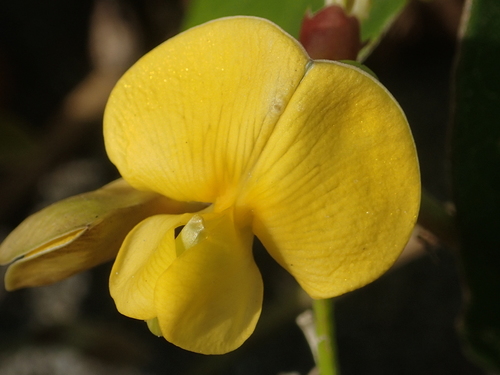
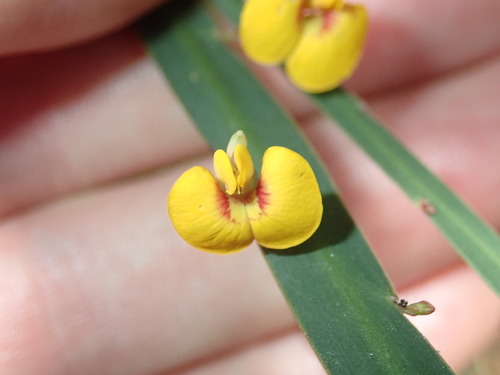
Bossiaea ensata is an erect, low-lying or sprawling, hairless shrub that typically grows 1 to 2 meters (3 feet 3 inches to 6 feet 7 inches) tall. It has flattened branches, along with flattened, winged cladodes that are 2 to 10 millimeters (0.079 to 0.394 inches) wide. When leaves do occur on this species, they are reduced to triangular scales 0.6 to 2 millimeters (0.024 to 0.079 inches) long. The flowers are 6 to 10 millimeters (0.24 to 0.39 inches) long, arranged singly in leaf axils on pedicels up to 4 millimeters (0.16 inches) long. There are two bracts up to 2 millimeters (0.079 inches) long at the base of the pedicel, and bracteoles located near the middle of the pedicel. The sepals are 3 to 4 millimeters (0.12 to 0.16 inches) long, joined at the base to form a bell-shaped tube, with the two upper sepals lobes longer than the three lower lobes. The standard petal is yellow with a red base, and has red streaks or blotches on its back. The flower wings are yellow, sometimes with a red tinge, and the keel is pale greenish yellow. Flowering takes place from September to October, and the fruit is an oblong pod that measures 25 to 40 millimeters (0.98 to 1.57 inches) long. Commonly called sword bossiaea, this species usually grows in sandy heath. It occurs on the coast and nearby tablelands of south-east Queensland, New South Wales and Victoria, extending west as far as Marlo. There is also a single recorded occurrence of this species in southern South Australia.