About Bossiaea aquifolium Benth.
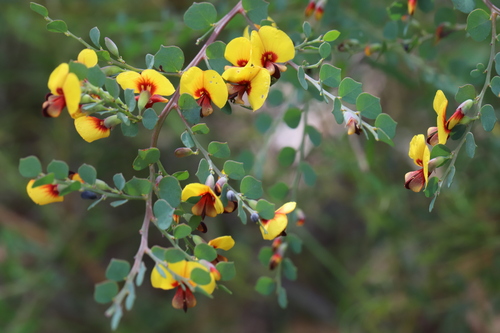
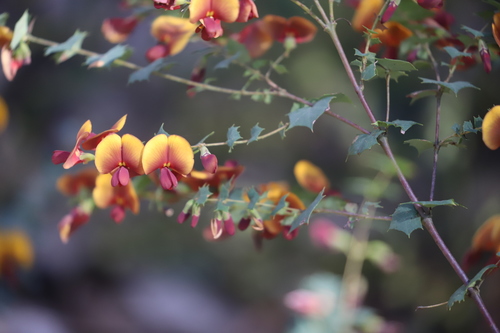
Bossiaea aquifolium Benth. is a slender shrub or tree that typically grows up to 8 metres (26 feet) tall, and has thin, sometimes hairy branchlets. Its leaves are arranged in opposite pairs, are holly-like in appearance, and range in shape from egg-shaped to roughly round. Leaf edges are either wavy with nine or more sharp points, or have more than fifteen teeth and only a single sharp point at the tip. Leaves measure 8–22 mm (0.31–0.87 in) long and 8–20 mm (0.31–0.79 in) wide, and grow on a petiole 0.9–2.2 mm (0.035–0.087 in) long. Broadly triangular stipules are present at the leaf base, and are shorter than the petiole. Flowers are borne singly or in pairs in leaf axils near the ends of branchlets, with egg-shaped bracts on the peduncle. The five sepals are joined at the base, forming a tube 2.3–4.2 mm (0.091–0.165 in) long. The upper two sepal lobes are 1–2 mm (0.039–0.079 in) long, while the lower three lobes are 0.8–1.5 mm (0.031–0.059 in) long. The standard petal is roughly round, 11.8–18 mm (0.46–0.71 in) long, and yellow to orange with a reddish-brown base. The wing petals are 9.7–13.7 mm (0.38–0.54 in) long, reddish, and sometimes orange or yellow near the tip. The keel petal is 10–13 mm (0.39–0.51 in) long, and deep red to reddish-brown. Flowering occurs from July to November. The fruit is an oval to egg-shaped pod 11–24 mm (0.43–0.94 in) long. Seeds are reddish to brownish, with approximately 70 seeds per gram. This species, commonly known as water bush, grows in clay or loam soils over laterite or granite. It is a common understorey shrub in forests dominated by jarrah and marri trees, found in the Jarrah Forest, Swan Coastal Plain and Warren biogeographic regions of south-west Western Australia. The nominate subspecies B. aquifolium subsp. aquifolium occurs from near Mundaring to near Margaret River, and inland to Collie and Nannup. B. aquifolium subsp. laidlawiana occurs from near Nannup and extends south to near Lake Muir. For horticultural use, this species can be grown from seed. It prefers light to medium, well-drained, moist soil in a semi-protected position. It is drought resistant, but susceptible to frost. Hot water treatment or scarification of the seed coat is recommended prior to planting.