About Borrichia frutescens (L.) DC.
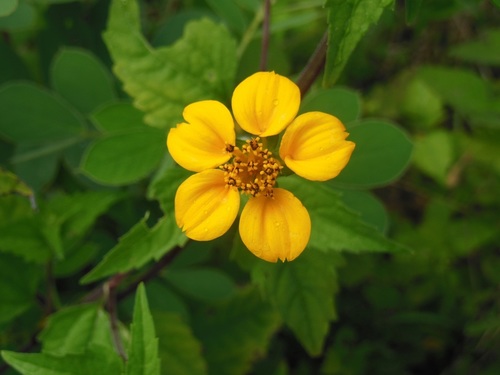
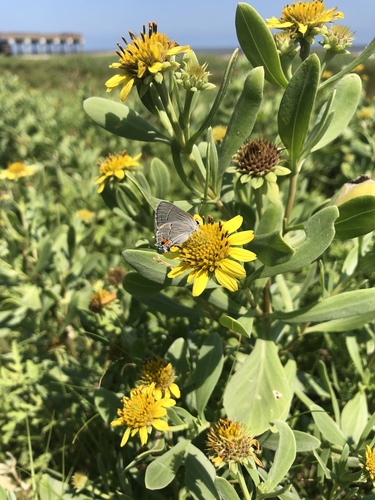
Borrichia frutescens (L.) DC. is a variable species. In general, it is a perennial herb or shrub that grows up to around 90 centimeters (3 feet) tall. Its above-ground plant tissue is gray-green to silvery, and fleshy. It produces oval to lance-shaped leaves that can reach 11 centimeters in length. Leaf blades have teeth near their bases, and are smooth-edged along the rest of the margin; the leaves are usually hairy. The leaf base or petiole almost always bears at least one spine. The inflorescence is a single, rounded flower head lined with phyllaries tipped with spines. The flower head holds 15 to 30 short yellow ray florets. Many yellow disc florets with black anthers sit at the center of the head. The fruit is a dark-colored, flattened, somewhat triangular cypsela that is a few millimeters long. As the flower head dries and flowers drop off, it develops into a hard, spiny, burr-like structure filled with these small fruits. This plant may live longer than five years. Across some parts of its range, this species grows alongside another member of its genus, Borrichia arborescens. The two often hybridize, producing the hybrid offspring named Borrichia × cubana, also called Cuban borrichia. This hybrid has variable morphology, but is usually intermediate in form between its two parent species. This plant grows alongside other typical salt marsh and coastal plant species including glasswort (Salicornia virginica), saltwort (Batis maritima), seashore saltgrass (Distichlis spicata), and annual seepweed (Suaeda linearis). The plant attracts butterflies. Other insects associated with this species include the delphacid planthopper Pissonotus quadripustulatus, aphids of the genus Uroleucon (formerly placed in Dactynotus), the leafhopper Carneocephala floridana, and the gall midge Asphondylia borrichiae. Pissonotus quadripustulatus and Asphondylia borrichiae are specialists that feed and live on this plant. The gall midge triggers the formation of galls in the plant’s apical meristem. Tissue damage in this growing region can halt the plant’s growth, stop it from flowering, and kill the entire affected stem. There is typically just one gall per plant, though each gall may have multiple chambers; this number is usually no more than three, but can occasionally reach as many as eight. Each chamber holds a midge larva that feeds on fungus growing inside the gall, before pupating and emerging as an adult gall midge. The galls also host several species of wasps that act as parasitoids of the midge.