About Boronia serrulata Sm.
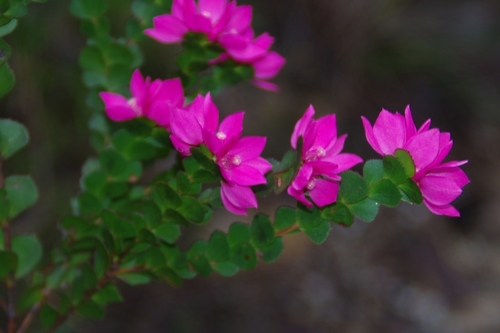
Boronia serrulata Sm. is an erect, woody shrub that typically reaches a height of around 1.5 m (4.9 ft). Its branchlets are mostly hairless (glabrous). The leaves are crowded, simple, broadly egg-shaped with the narrower end at the base, between 6–18 mm (0.24–0.71 in) long and 1.5–9 mm (0.059–0.354 in) wide, and grow without a stalk (sessile). Both sides of the leaf are the same colour, and the leaf edges have fine teeth. Up to seven cup-shaped flowers grow at the ends of branchlets on a stalk (peduncle) that can be up to 3.5 mm (0.14 in) long; individual flowers are either sessile or grow on a flower stalk (pedicel) up to 3.5 mm (0.14 in) long. It has four triangular sepals, 2.5–3 mm (0.098–0.118 in) long and roughly 2 mm (0.079 in) wide, and four bright pink petals 6–11 mm (0.24–0.43 in) long. The eight stamens have a dense tuft of hairs near the tip, and the style is hidden by a greatly enlarged stigma. Flowering takes place from August to November, and the fruit is a mostly glabrous capsule around 4 mm (0.16 in) long and 2 mm (0.079 in) wide. Commonly called native rose, this species grows in sandy soil in moist heath, mainly in near-coastal areas of the Sydney basin. In horticulture, Boronia serrulata is described as an attractive shrub with bright green aromatic leaves that release scent when crushed. It is most easily propagated from semi-hardwood cuttings taken in early summer, and grows best in well-drained soil with a cool root run.