About Boronia parviflora Sm.
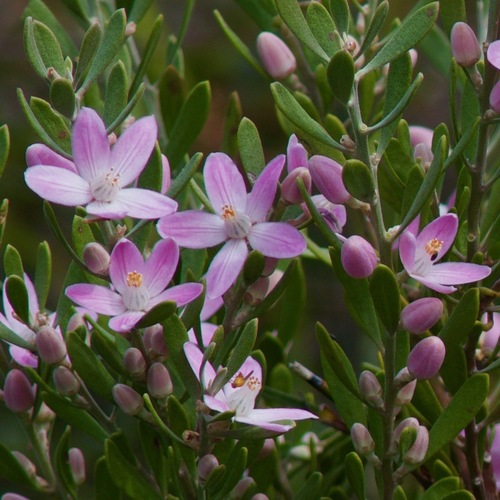
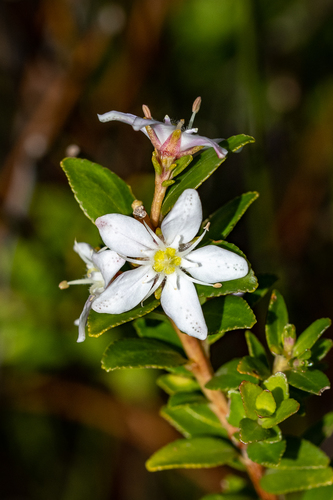
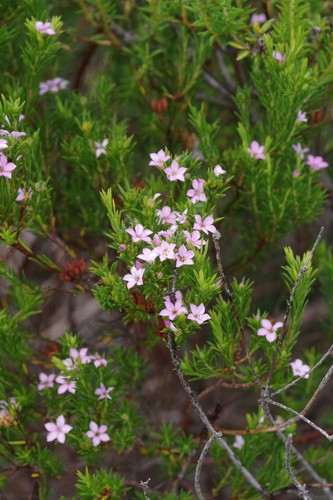
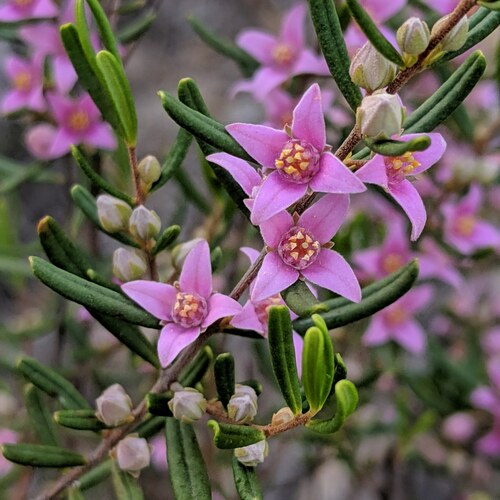
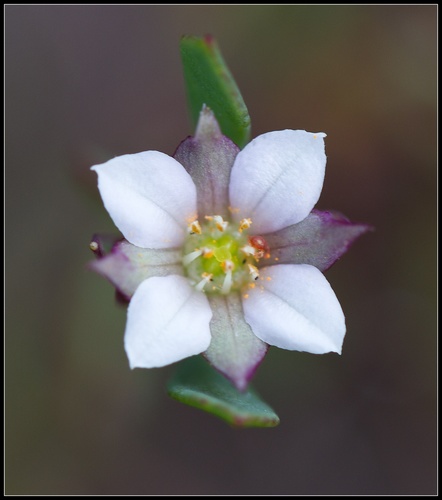
Boronia parviflora Sm. is a weak, low-growing shrub that reaches a height of 0.1 to 1 meter (0.3 to 3 feet), and has hairless branchlets. Its leaves are simple, stalkless, and range in shape from elliptic to egg-shaped. They measure 7 to 26 millimeters (0.28 to 1.02 inches) long and 1.5 to 6.5 millimeters (0.059 to 0.256 inches) wide, with fine teeth along their edges. Leaves are sometimes reddish or purplish, most noticeably on their lower surface. Flowers are borne singly or in groups of up to three, in upper leaf axils or at the ends of branches, on a stalk 2 to 11 millimeters (0.079 to 0.433 inches) long. This species has four sepals that are roughly triangular, green or red, hairless, and 2.5 to 6 millimeters (0.098 to 0.236 inches) long. The four petals are pale to bright pink, white, or sometimes green, are about the same length as the sepals, and have overlapping bases. The stamens are hairy, and the stigma is very small. Plants from Queensland, New South Wales, and Tasmania always have eight stamens, while plants from western Victoria and South Australia sometimes only have four or six. Flowering occurs mainly from August to March. The fruit is a hairless capsule that is 2 to 4 millimeters (0.079 to 0.157 inches) long and 1.5 to 2.5 millimeters (0.059 to 0.098 inches) wide. Commonly called swamp boronia, this plant grows in seasonally wet areas of heath, woodland, sedge, and wallum habitat. It is the most widely distributed species of boronia, found in near-coastal areas south from the Sunshine Coast in Queensland, extending through New South Wales inland as far as Boonoo Boonoo. It also occurs throughout Tasmania, in scattered locations across southern Victoria, and in south-eastern South Australia.