About Boronia muelleri (Benth.) Cheel
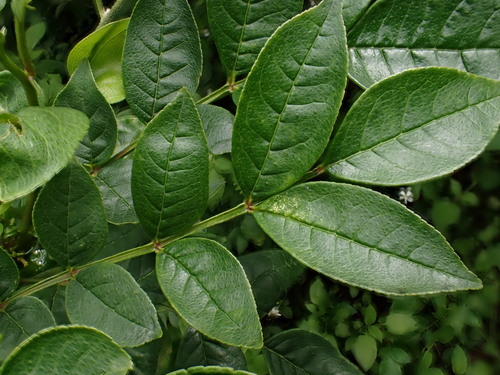
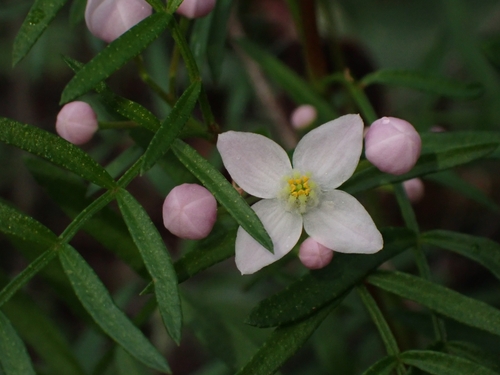
Boronia muelleri is an erect, woody shrub or small tree that reaches a height of 0.8 to 3 meters (2 feet 7 inches to 9 feet 10 inches), and has warty glands on its branchlets. Its leaves are scented and pinnate, with between seven and seventeen leaflets. The leaf outline is 45 to 70 millimeters (1.8 to 2.8 inches) long and 20 to 45 millimeters (0.79 to 1.77 inches) wide, growing on a petiole 6 to 12 millimeters (0.24 to 0.47 inches) long. The end leaflet is narrow elliptic or oblong, 4 to 24 millimeters (0.16 to 0.94 inches) long and 1 to 3.5 millimeters (0.039 to 0.138 inches) wide, while side leaflets have a similar shape but are usually longer. Flowers are arranged in groups of up to fifteen in leaf axils, growing on a peduncle 4 to 15 millimeters (0.16 to 0.59 inches) long. The four sepals are egg-shaped to triangular, 1.5 to 2 millimeters (0.059 to 0.079 inches) long, and glabrous. The four petals are pale to deep pink or white, 4.5 to 7.5 millimeters (0.18 to 0.30 inches) long, and the eight stamens are hairy. Flowering occurs mainly from August to February, and the fruit is a glabrous capsule 3 to 4 millimeters (0.12 to 0.16 inches) long and 1.5 to 2 millimeters (0.059 to 0.079 inches) wide. This species most often grows in moist sandy soil within forest, woodland and heath habitats. It occurs in New South Wales south from Eden, through to Buchan in eastern Victoria, with isolated disjunct populations near Labertouche and Chapple Vale.