About Boronia citriodora Gunn ex Hook.fil.
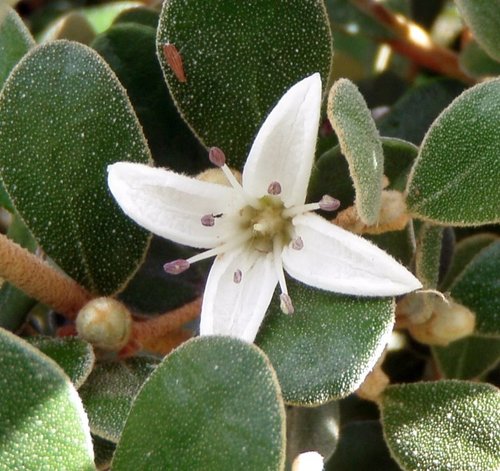
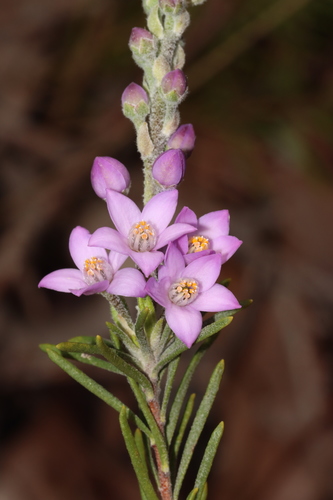
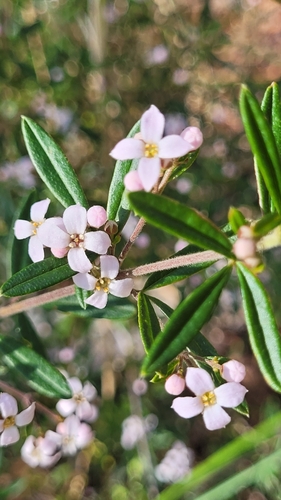
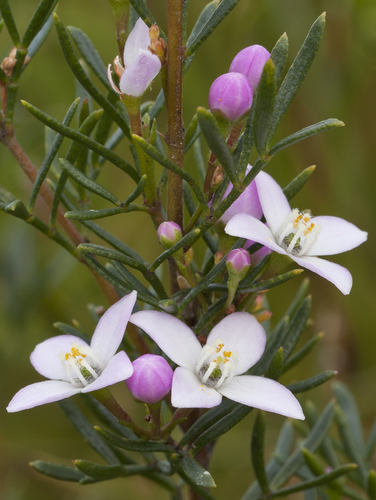
Boronia citriodora is a woody shrub that may be prostrate or erect, reaching up to 3 metres (9.8 feet) in height. It produces pinnate leaves that are 7–25 millimetres (0.28–0.98 inches) long and 7–30 millimetres (0.28–1.2 inches) wide in outline, with between 3 and 9 leaflets growing on a petiole 1.5–6 millimetres (0.059–0.24 inches) long. The end leaflet is narrow elliptic to narrow lance-shaped, 3.5–15 millimetres (0.14–0.59 inches) long and 0.5–4 millimetres (0.020–0.16 inches) wide, and side leaflets are similar in shape but longer. Flowers range from white to pink, and are arranged singly or in groups of up to seven in leaf axils or on branch ends, growing on a stalk 1–8 millimetres (0.039–0.31 inches) long. This species has four triangular sepals that are 0.5–2.5 millimetres (0.02–0.1 inches) long and wide, four petals 3.5–8.5 millimetres (0.1–0.3 inches) long, and eight stamens that bear a few short hairs. Flowering occurs between November and February. Mature fruits are smooth, 3–4 millimetres (0.12–0.16 inches) long and 1.5–2 millimetres (0.059–0.079 inches) wide. Commonly called lemon-scented boronia, this plant grows in heath, woodland, and areas near rainforest, most often in rocky locations. Subspecies citriodora grows only on the Central Highlands of Tasmania at altitudes above 900 metres (3,000 feet), with isolated disjunct populations further south including on Mount Field. Subspecies orientalis is only known to occur at Ben Lomond and Mount Barrow. Subspecies paulwilsonii is only known from the south-west of Tasmania, south of Macquarie Harbour and west of Mount Shea. Boronia citriodora is cultivated as an ornamental garden plant. It tolerates sun, shade, wind, heavy frost, and both dry, sandy and waterlogged soils.