About Boronia barkeriana F.Muell.
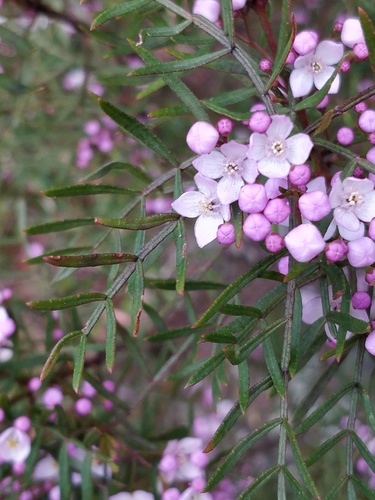
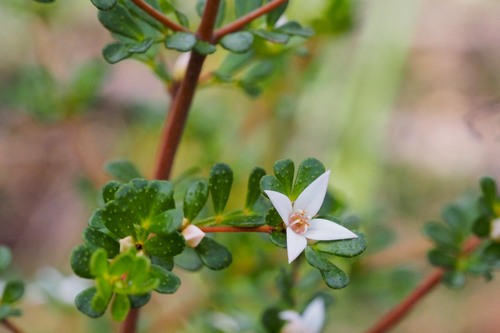
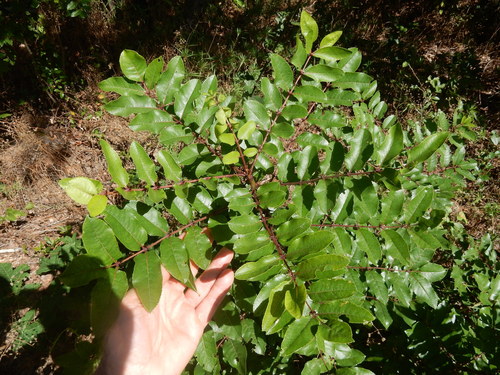
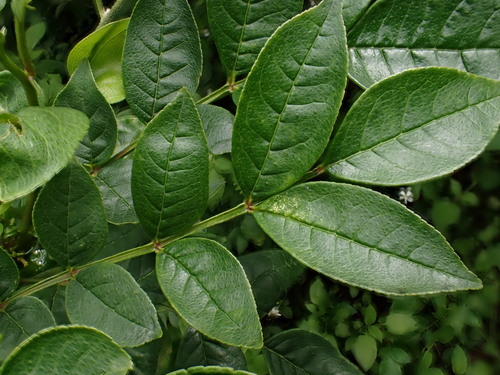
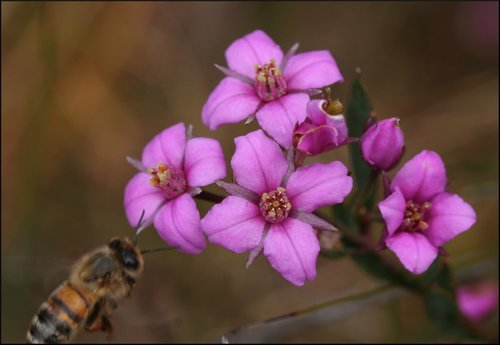
Boronia barkeriana is a shrub with ground-hugging branches that reaches a height between 0.2 and 1 metre (0.7 to 3 feet). Its stems are hairless and often reddish. It produces simple leaves that range from narrow lance-shaped to narrow egg-shaped, with lengths between 10 and 33 millimetres (0.39 to 1.3 inches) and widths between 2 and 10 millimetres (0.079 to 0.39 inches). Most leaves do not have a petiole, have small teeth along their edges, and are often reddish on the edges and undersides. Groups of two to eight bright pink to pinkish mauve flowers grow in leaf axils, each flower carried on a pedicel 4 to 18 millimetres (0.2 to 0.7 inches) long. This species has four purple sepals that are shaped triangular to egg-shaped, about 1.5 to 8 millimetres (0.06 to 0.3 inches) long and 1 to 6 millimetres (0.04 to 0.2 inches) wide. It has four petals 5 to 11 millimetres (0.2 to 0.4 inches) long, with overlapping bases. The eight stamens have hairy edges. Flowering occurs mainly from September to December, and the mature fruit are hairless, about 4 millimetres (0.16 inches) long and 2 millimetres (0.079 inches) wide. This boronia grows in moist locations on sandstone. Three subspecies have distinct ranges: subspecies angustifolia grows mainly in Morton National Park and Budderoo National Park; subspecies barkeriana grows on the coast and ranges near Braidwood; subspecies gymnopetala has only been recorded in the area between Port Jackson and Waterfall, has not been collected since 1923, and is presumed extinct.