About Boronia algida F.Muell.
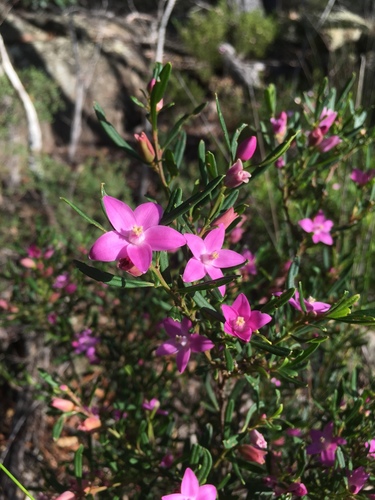
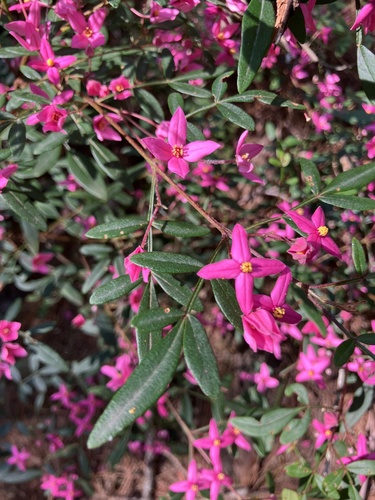
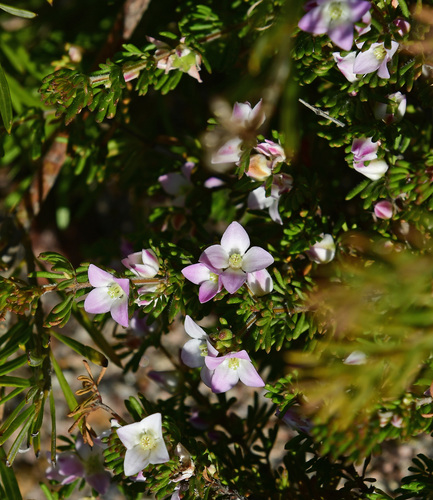
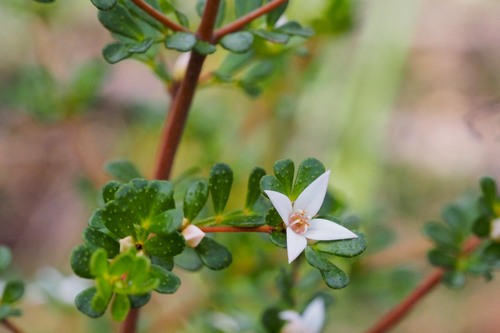
Boronia algida F.Muell. is a shrub that reaches a height between 0.3 and 1.5 meters (1 to 5 feet). It produces many branches that are more or less hairy, and the youngest of these branches are often red. Its leaves are pinnate, with an overall outline that is 8 to 15 millimeters long and 4 to 5 millimeters wide. The leaves usually hold between five and nine leaflets, and attach to a petiole 0.5 to 1 millimeter long. The terminal leaflet measures 2 to 8 millimeters long and 1 to 3.5 millimeters wide, while the side leaflets are 2 to 9 millimeters long and 1 to 4.5 millimeters wide. Flowers of this species are white to bright pink, and they are borne singly, or sometimes in groups of up to three at the ends of branches. This plant has four triangular to egg-shaped sepals that are 1 to 2.5 millimeters long and 0.5 to 1.5 millimeters wide, and four petals that are 4 to 7 millimeters long and 2.5 to 3 millimeters wide. The eight stamens alternate in length, with stamens near the sepals being longer than those near the petals. Flowering takes place from September to February, and the mature fruit are smooth capsules that are 2.5 to 3 millimeters long and 1.5 to 2 millimeters wide. This alpine boronia grows in heath and forest, mostly in sandy soil over granite at higher elevations. Its range extends from south of the Gibraltar Range in New South Wales to the Australian Capital Territory, as well as to Mount Buffalo, Mount Hotham, and the Nunniong Plateau in Victoria.