About Borassus flabellifer L.
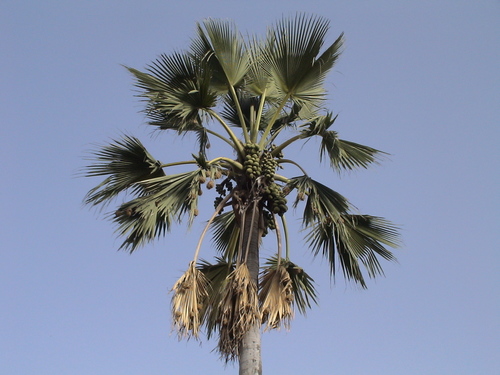
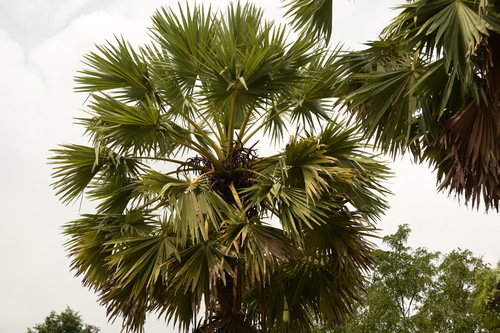
Borassus flabellifer L. is a robust tree that can reach a height of 30 metres (98 ft). Its trunk is grey, strong, and marked with ring-shaped leaf scars; old leaves stay attached to the trunk for several years before falling off cleanly. The leaves are fan-shaped and 3 m (9.8 ft) long, with tough black teeth along the edges of the petioles. Like all species in the Borassus genus, B. flabellifer is generally dioecious, meaning male and female flowers grow on separate individual plants. Very rarely, however, individual trees have been observed to bear both male and female flowers. Male flowers are less than 1 centimetre (0.39 in) long, and form semi-circular clusters hidden beneath scale-like bracts within catkin-shaped inflorescences. In comparison, female flowers are the size of golfballs, grow singly, and sit directly on the surface of the inflorescence axis. After pollination, the flowers develop into fleshy fruits 15–25 centimetres (5.9–9.8 in) wide, with each fruit holding 1 to 3 seeds. The fruits range in color from black to brown, and have sweet, fibrous pulp; each seed is enclosed in a hard, woody endocarp. Young palmyra seedlings grow slowly, producing only a small number of new leaves each year during their establishment phase. After an as-yet undetermined length of time, they switch to rapid growth and develop a large, substantial stem. As an ornamental tree, B. flabellifer is valued for its growth pattern, very large size, and clean growth habits, which make it an attractive choice for planting in gardens and parks as a landscape palm species. It has been cultivated in Karachi, Pakistan.