About Borassus akeassii Bayton, Ouédr. & Guinko
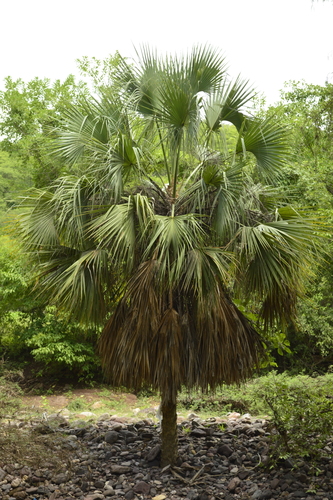
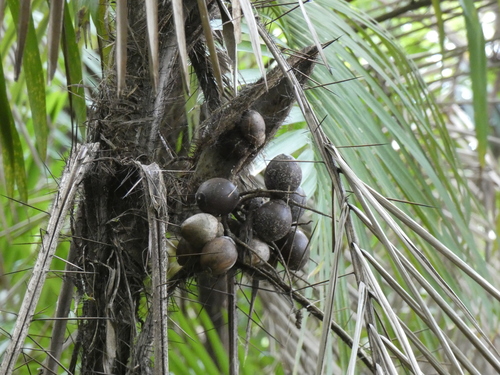
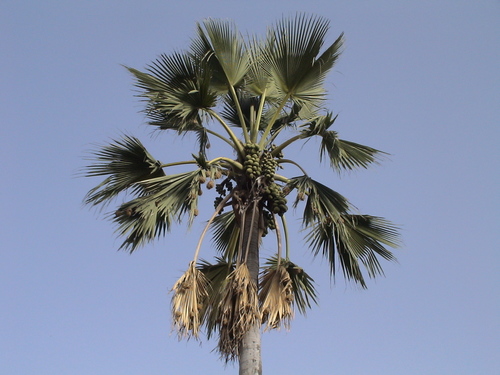
This palm species grows to an impressive height of 15 meters, and typically develops a noticeably swollen trunk that often bears numerous irregular scars, which are usually caused by external influences. Its crown holds a moderate to dense number of glaucous, fan-shaped leaves. Each leaf is supported by a sturdy petiole that has serrated black teeth along its edges, though some petioles have nearly smooth margins instead. The leaf blade is relatively flat, and is divided into many rigid leaflets with pointed tips that may split as time passes. Fine, persistent hairs can sometimes be found along the ribs of younger leaves, and these hairs gradually fade as the leaves mature. The adaxial hastula is well-defined, while the abaxial hastula is less prominent. Male and female inflorescences have clearly different structures: male inflorescences branch multiple times and form catkin-like spikes, while female inflorescences are usually either spicate or only minimally branched. The rachillae of male flowers often end in small, rounded projections that hold tightly arranged clusters of flowers. Female flowers are much larger, arranged spirally along the rachis, and enclosed within protective bracts. The fruits are distinctly large, ovoid, and slightly pointed at the tip, and give off a noticeable fragrance when they ripen to a yellowish-green color. Each fruit contains one to three large seeds, which are enclosed in a tough, woody endocarp. Pollen grains have a reticulate texture, with a dense covering of minute surface structures. The palm's striking appearance and structural adaptations make it a notable part of its native habitat.