About Boquila trifoliolata (DC.) Decne.
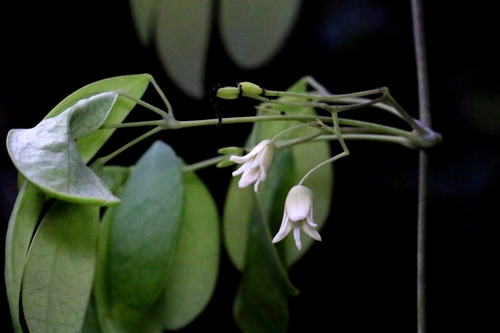
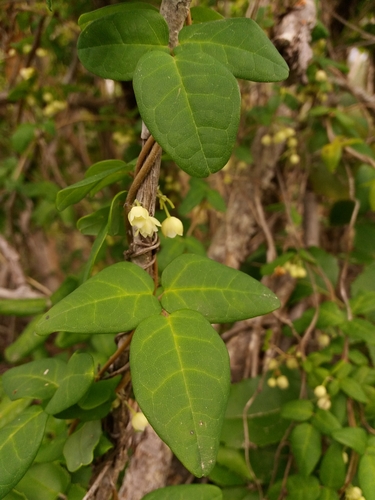
Boquila trifoliolata (DC.) Decne. is a woody vine with highly variable appearance due to its crypsis abilities. The vines are either evergreen or partly deciduous, meaning they largely retain their leaves through winter. When climbing host plants, the vines grow in a twining pattern, where stems bend around host plants as they ascend. Its branches are thin, less than 0.39 inches (1 cm) in diameter, covered in red-brown bark. Its lenticels are elliptical in shape, and wider branches are speckled grey. When it is not mimicking a host plant, B. trifoliolata produces smaller "charlatan leaves" that are short, stubby, and three-lobed (trifoliate). Leaf petioles range from 0.79 inches (2 cm) to 2.4 inches (6 cm) in length, and petiolules range from 0.20 inches (0.5 cm) to 0.59 inches (1.5 cm) in length. Leaflets are oval or elliptical, ranging from 0.79 inches (2 cm) to 2.4 inches (6 cm) in height and 0.39 inches (1 cm) to 1.2 inches (3 cm) in width. Leaf bases are rounded, margins are irregular and most often trilobate, tips are rounded and wide-angled. The upper surface of leaves is dark green and hairless, the undersides are glaucous, a pale-grey to blue-green color, and leaf veins follow a pinnate pattern.
The entire Boquila genus is endemic to temperate rainforests, Nothofagus forests, and evergreen forests of southern Argentina and Chile, with a range from Cauquenes to Chiloe. B. trifoliolata is most commonly found at elevations between 330 feet (100 metres) and 2,000 feet (600 metres). Unlike many other vine species, B. trifoliolata is not parasitic. It only attaches to trees for structural support and protection, and sometimes forms thickets over 20 feet (6 metres) tall. B. trifoliolata can survive temperatures as low as 18 °F (−8 °C), prefers humus-rich soil, is resistant to wilting, and generally grows best in shaded environments.
In its native Southern Hemisphere habitat, flowering occurs between September and December, and fruiting occurs between January and March. This timing is reversed when the plant is grown in the Northern Hemisphere. B. trifoliolata is monoecious, meaning a single individual produces both male and female floral parts. Its flowers have small petals 0.59 inches (1.5 cm) to 1.2 inches (3 cm) long, colored green-white to yellow-white. Flowers grow in umbels of 2 to 4 flowers, with small hairs and lepidote bracts along the petals. Each flower has six sepals, arranged in two whorls, with a petal-like, ovate shape; the three inner sepals are larger than the three outer sepals. Male (staminate) flowers have six stamens with oppositely arranged petals and oblate anthers. Female (carpellate) flowers have six conical staminodes, three carpels, an elongated stigma, and vertical sutures running up the petals. Fruits are small, 0.20 inches (0.5 cm) to 0.39 inches (1 cm) in diameter, and white. Each berry typically holds 1 to 4 seeds that measure 0.098 inches (2.5 mm) to 0.20 inches (5 mm). The seeds are oval, brown, and contain large amounts of endosperm. Seeds are mostly dispersed by animal vectors and germinate readily when planted.
Local people use the stems of B. trifoliolata for basketry and rope making. Historically, local tribes used leaf juice to treat sore eyes, and it was once thought to be an aphrodisiac. This species is grown as an ornamental plant, its berries are edible, and it is commonly propagated by cutting stems in summer and rooting them in cold frames.