About Bondarzewia berkeleyi (Fr.) Bondartsev & Singer
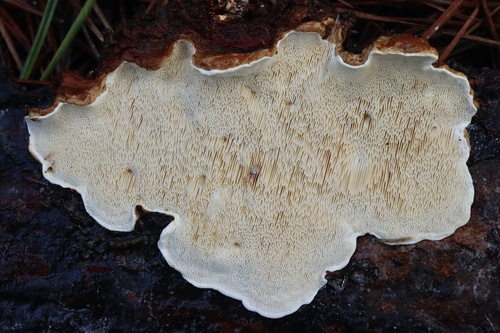
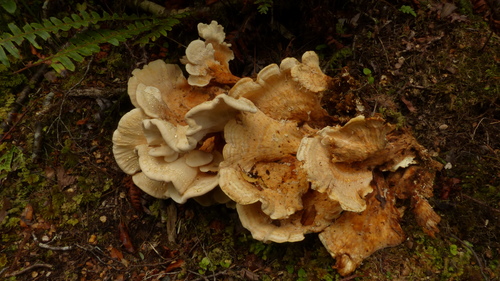
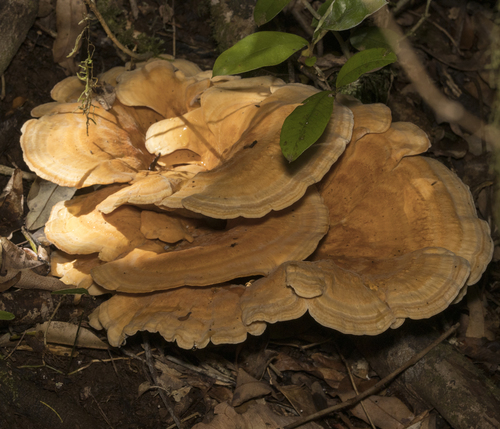
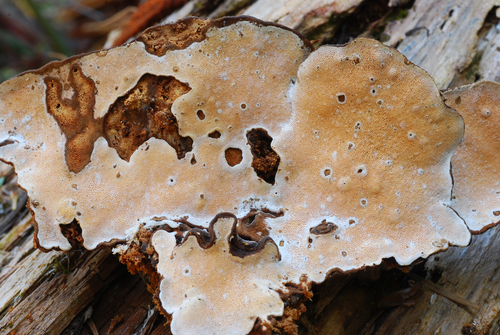
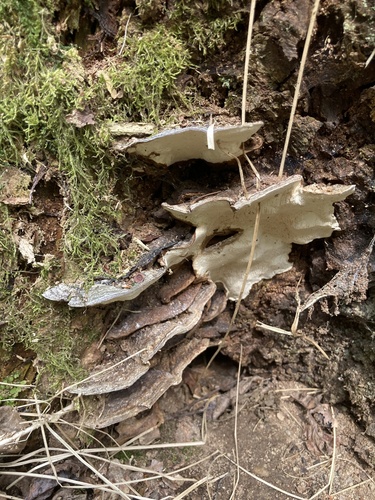
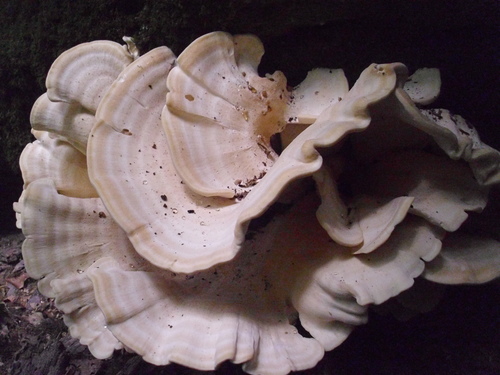
The fan- or shelf-shaped caps of Bondarzewia berkeleyi grow in overlapping clumps from the bases of trees, with each cap reaching 20–50 centimetres (8–19+1⁄2 inches) in diameter. The caps show zonation in various shades from white to pale grey, cream, beige or yellow. Both the pore surface and the spore print are white. The round spores measure 7–9 by 6–8 μm and have distinct amyloid ridges. The tough white flesh can be up to 3 cm (1+1⁄4 inches) thick; it has a mild taste when young, turning bitter as it ages. The outer edges of the caps are quite tender and cut easily with a knife. Bondarzewia berkeleyi has a widespread distribution, found in Europe, Asia, Africa, and North America east of the Great Plains, where it can be encountered from June to October. Its primary host tree is oak, but it has also been observed growing on other hardwood species such as maple. In China, it has been recorded from Guangdong and Hunan provinces. In the United States, fruit bodies appear from July to October. A survey of host trees in North Carolina found that this fungus almost always grows on oaks; recorded host species there include white oak (Quercus alba), scarlet oak (Q. coccinea), southern red oak (Q. falcata), chestnut oak (Q. prinus), eastern black oak (Q. velutina), and bird cherry (Prunus pensylvanica). Bondarzewia berkeleyi is a parasitic fungus that causes butt rot in oaks and other hardwood trees. It produces a white stringy rot in the roots and heartwood of the lower trunk, and this rot typically does not extend more than 0.9–1.5 m (3–5 ft) upwards along the trunk. Decay is mainly restricted to the heartwood, and possible external symptoms include excessive tapering or flaring at the base of the trunk, cracks, seams, and sap flow. Compared to other common wood-rotting fungi that grow on oaks, Bondarzewia berkeleyi has a notably rapid growth rate. While it is primarily a parasite, it can also act as a saprophyte, growing successfully on dead hardwood trees or stumps. Fruiting bodies typically appear on infected trees during summer and fall.