About Bombus wurflenii Radoszkowski, 1860
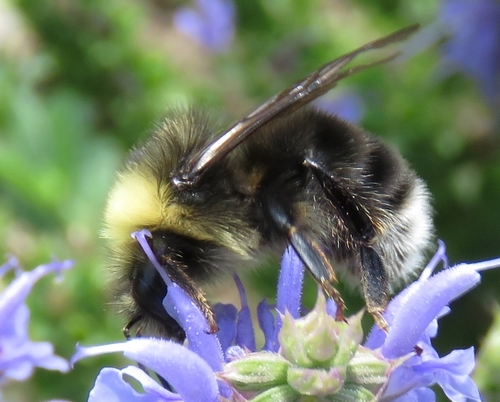
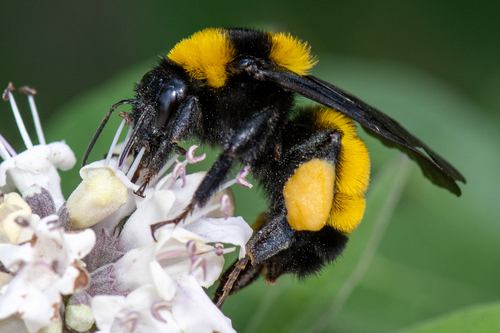
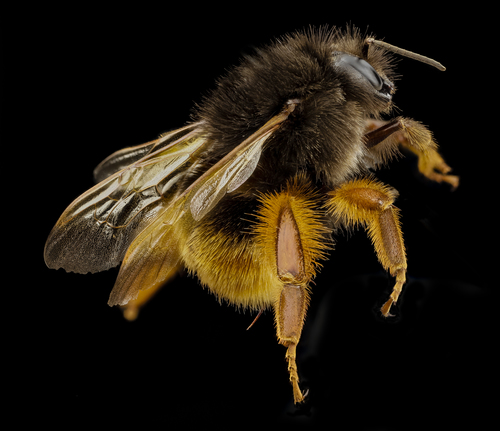
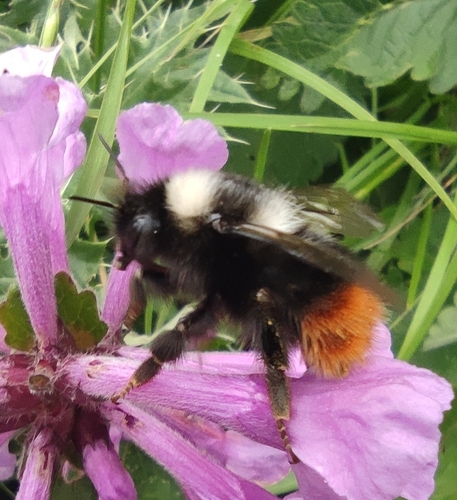
Bombus wurflenii is a species of bumblebee first described by Radoszkowski in 1860. This bumblebee has a very short proboscis (tongue), powerful toothed mandibles, and a short head. Queens measure 19 to 22 mm (0.75 to 0.87 in) in body length, with a wingspan of 36 to 41 mm (1.4 to 1.6 in). They have black shaggy fur covering their bodies, including the three final abdominal segments (terga). Workers range from 13 to 16 mm (0.51 to 0.63 in) in body length, with a wingspan of 25 to 32 mm (0.98 to 1.26 in), and resemble queens except for their smaller size. Males are 14 to 16 mm (0.55 to 0.63 in) in body length, with a wingspan of 28 to 32 mm (1.1 to 1.3 in), and are otherwise similar in appearance to females. All females have nearly clear wings with dark brown veins, long body hair, an oculo-malar area (the space between the eye and mandible) that is shorter than it is broad, and a flat clypeus (front facial segment) that is not raised in the center. The clypeus has an uninterrupted shallow transverse groove, and its central section has many small, uniform punctures and is not shiny. The hair on the top of the female thorax is black, with grey-white hair bands at the front and usually at the rear. Males also have nearly clear wings with dark brown veins and long body hair. Male genitalia of this species are distinctive: the gonostylus is long and convexly rounded at the tip, with an outer side around one quarter the length of its inner side. The penis-valve head is strongly recurved into a hook that is much longer than it is broad, and ends in a broad rounded tip. The hair on the top of the male thorax between the wing bases is either predominantly pale cream-yellow, or has many pale cream-yellow hairs mixed in. The species shows some color pattern variation across its north-to-south range. In Turkey and the Caucasus, females have a white-banded, red-tailed color pattern. This pattern is considered a form of mimicry, that lets them resemble more abundant bumblebee species in the area, such as B. incertus and B. eriophorus. Bombus wurflenii is distributed across West Asia, including Turkey, Georgia, Armenia, Azerbaijan, and Iran. Its range also extends into Russia, specifically to the Caucasus and the Ural Mountains. The species occurs mainly in mountainous areas. In Turkey, it is found at altitudes from 1,600 metres (5,200 ft) to 2,600 metres (8,500 ft). Its nests are small, holding 80 to 150 individual bees. This bumblebee predominantly forages on flowers from the genera and families Vaccinium, Lamiaceae, Scrophulariaceae, and Fabaceae. According to researcher Goulson, this species is an opportunistic nectar robber. The bees cut a hole into the back of a flower to access nectar, and as a result do not participate in pollination.