About Bombus vosnesenskii Radoszkowski, 1862
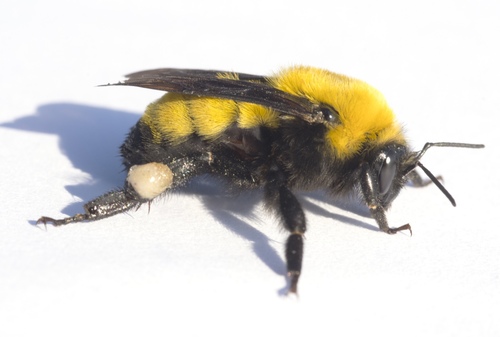
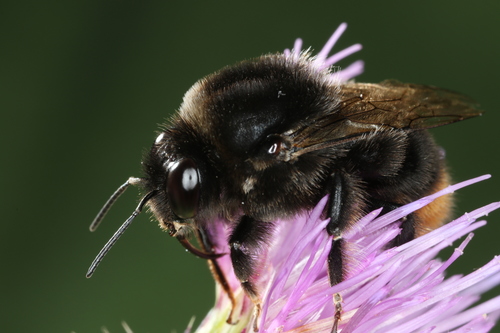
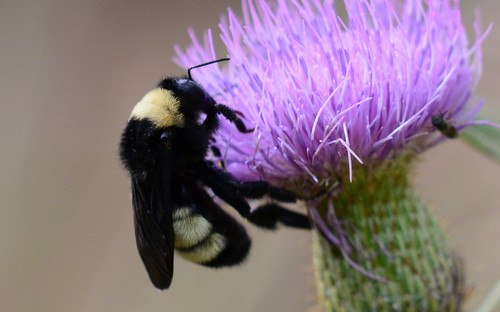
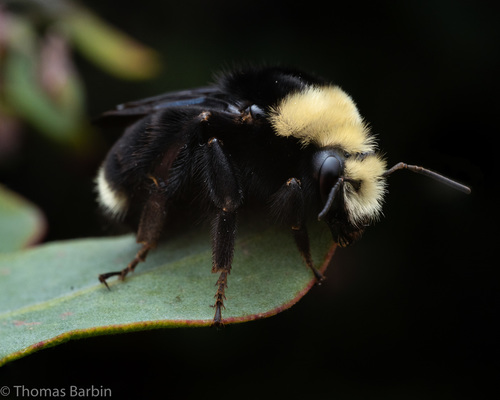
Bombus vosnesenskii Radoszkowski, 1862 has several distinct identifying features. These include short, uniform hair, a rounded angle on the basitarsus of the middle leg, a square face, and a pollen basket (corbicula) formed by fringed hair on the hind legs. Size varies by caste: queens are 18–21 mm long, workers 8–17 mm, and males 10–15 mm. All castes have medium-length antennae and similarly shaped, similarly sized eyes, and bodies patterned with black and yellow hairs. Queens and female workers almost always share identical coloration: their thorax is nearly entirely black, with yellow stripes at the head and at the T4 abdominal segment. Male drones are mostly similar to females, but some males have more yellow on the sides that extends further up the back of the thorax. While historical distribution data for insects across western North America is limited, Bombus vosnesenskii is not undergoing population decline. It is one of the most common bee species on the West Coast of the United States, and the most common bumble bee from Oregon northward. Its nesting range extends from British Columbia to Baja California. Historically, the western bumble bee (Bombus occidentalis), which ranged from California to British Columbia and Alaska, was the most common bumble bee in this region. However, diseases introduced by commercial rearing operations in the eastern United States pushed coastal populations of B. occidentalis to the brink of extinction, and B. vosnesenskii has filled the newly vacant ecological niche. This species' successful occupation of the niche left by B. occidentalis has not resulted in an undisturbed, balanced natural community. In the San Francisco area, the frequency of B. vosnesenskii occurrences is inversely correlated with local bee species richness, which indicates that B. vosnesenskii outcompetes other bee species for space and resources. This competitive advantage may come from the species' early seasonal emergence, which lets it claim and monopolize available nest spaces. B. vosnesenskii nests underground, with typical colony sizes holding 200–300 workers. Though it is not currently declining, the species does have reduced nesting density in urbanized landscapes. A Santa Barbara, California case study found that local grassland restoration can provide habitat refugia for this species in urbanized areas. This bee's pollination and foraging preferences are shaped by location and landscape features, rather than colony membership. This indicates that competition between B. vosnesenskii colonies does not create selective pressure that shapes their foraging behavior. Additionally, the species does not choose foraging targets based on plant abundance or availability. There is very little correlation between the most abundant floral taxa and the taxa most frequently foraged by B. vosnesenskii. Certain plant species—including Lotus corniculatus, Prunus montana, and Lavandula stoechas—are highly preferred by B. vosnesenskii even when they occur at relatively low abundances. These ranked foraging preferences are consistent among all bees from the same region, rather than varying between individual bees or different colonies. The yellow-faced bumble bee (B. vosnesenskii) selects foraging locations based on the diversity of flora present in a given area, rather than the total density of flowers. This means the bees will travel longer distances to forage in patches with a wider variety of available floral taxa. One possible explanation for this behavior is that the bees need to increase the variety of nutrients they consume by diversifying their nectar intake. In addition, bees that develop preferences for multiple plant genera will likely have more stable food resources over long time periods.