About Bombus vancouverensis Cresson, 1879
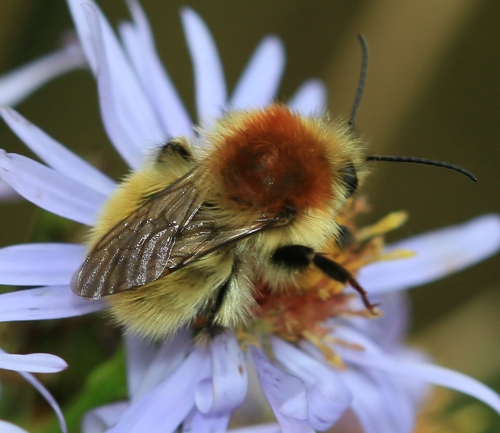
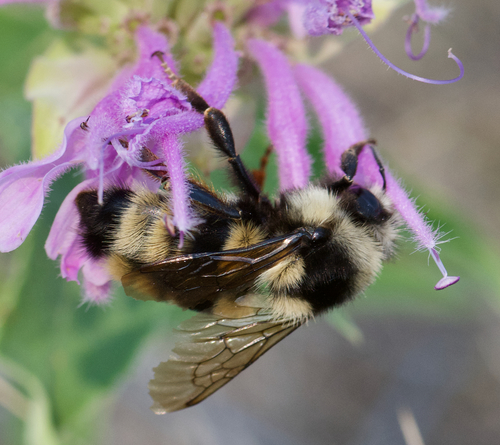
Description and identification: Bombus vancouverensis workers have a relatively small body size ranging from 8 to 14 mm (0.31 to 0.55 in), while queens measure 15 to 19 mm (0.59 to 0.75 in). Their bodies are covered in short, even hair. Individuals of this species display multiple distinct color forms, though these variants share many common characteristics. The hair on their faces is typically yellow or white, and sometimes has black coloring on the top of the head. Black coloring also appears across at least the lowest third of the thorax. Their hindlegs and pollen baskets are either brownish-orange or black, and this color depends on whether the third metasomal tergite (abdominal segment) is black. In the red-tailed color variant, the second and third metasomal tergites are red; in the black-tailed color variant, both the second and third metasomal tergites are black. Distribution and habitat: Bombus vancouverensis occurs throughout mountainous regions of western North America. In the United States, it has been recorded in parts of Alaska, California, Idaho, Montana, Nevada, Oregon, South Dakota, Utah, Washington, and Wyoming. In Canada, it has been found in Alberta, British Columbia, Manitoba, the Northwest Territories, Saskatchewan, and Yukon. This bumblebee species lives in a wide range of habitats, including open grassy fields, parks, prairies, shrubs, and mountainous areas. Buzz pollination: Like many other bumblebees, Bombus vancouverensis collects pollen from flowers through a process called buzz pollination. During this process, the bee sonicates the flower's anthers, shaking pollen loose from the anthers to collect it into its pollen sacs. Due to their small body size, B. vancouverensis individuals hang upside-down on flowers while performing buzz pollination.