About Bombus terricola Kirby, 1837
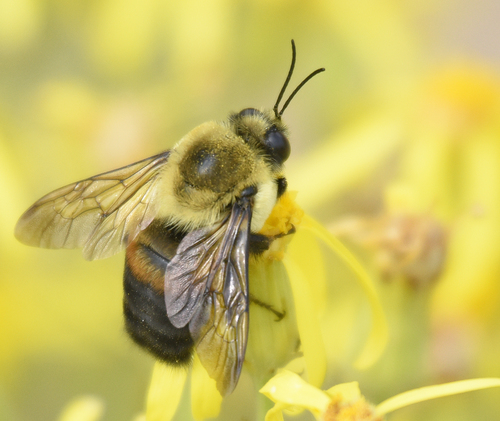
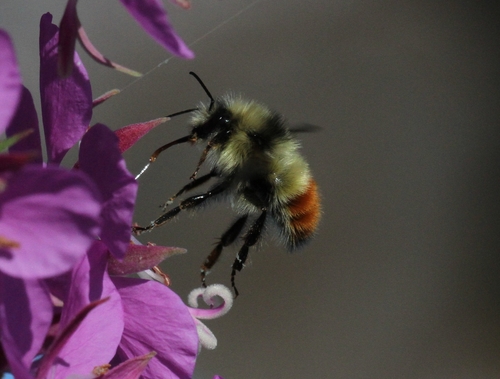
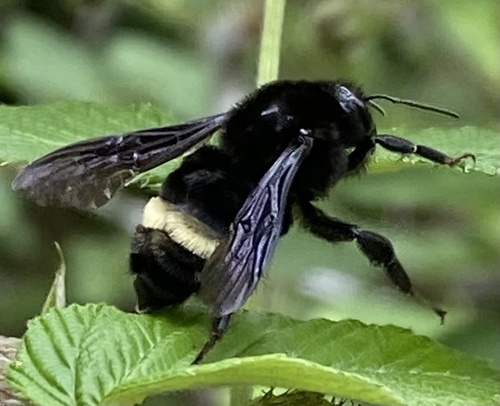
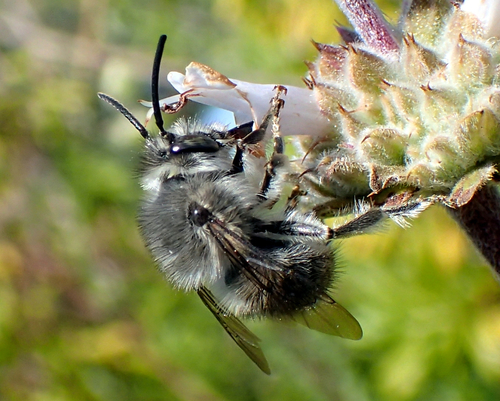
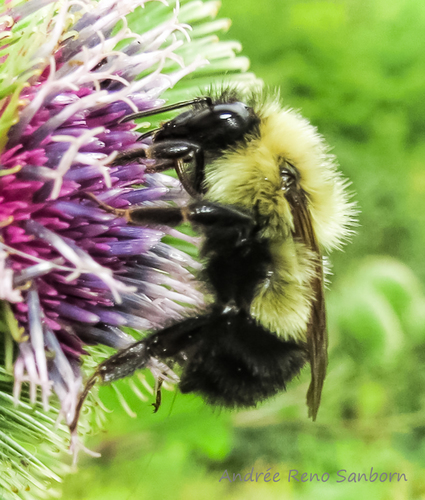
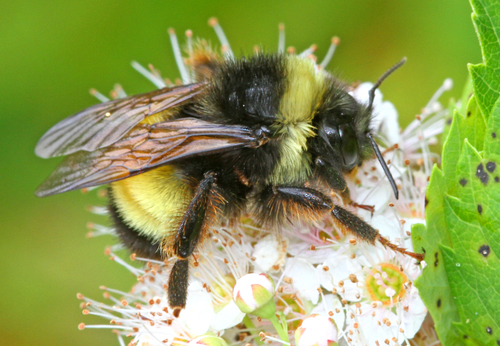
Bombus terricola Kirby, 1837, commonly called the yellow-banded bumble bee, has a black and yellowish-tan body, with a characteristic fringe of short yellow-brown hairs on its fifth abdominal segment. Queens measure approximately 18 mm (0.7 in) in length. The front half of the queen's thorax is yellowish-brown; this color also appears on abdominal segments 2, 3, and 4, and the sides of abdominal segment 6. All other parts of the queen's thorax and abdomen are black. Workers share a similar appearance to queens but are smaller, ranging from 9 to 14 mm (0.35 to 0.55 in) long. Males are intermediate in size between workers and queens, measuring 13 to 17 mm (0.5 to 0.7 in) long. For males, abdominal segments 2, 3, and 7 are yellowish-brown, and the sides of abdominal segment 6 are usually yellowish-brown as well.
This bumble bee species is found in eastern and Midwestern regions of the United States, as well as southern Canada. It occupies a very wide range of habitats, including urban areas, meadows, grasslands, wetlands, woodlands, and farmlands, and can also live in habitats ranging from alpine meadows to lowland tropical forests.
In Bombus terricola colonies, there is female-biased sex investment ratio. Colony workers attempt to shift the sex ratio to 3:1 in favor of female worker bees, to support their own gene propagation. However, the queen attempts to shift the ratio back to an even 1:1 of males to females for her own reproductive benefit. This interaction is called kin conflict, a phenomenon commonly observed in bees. B. terricola queens typically mate only once in a single mating flight, where they mate with multiple males. The queen stores all received sperm in a specialized organ called a spermatheca, and only one sperm from this storage will fertilize each of her eggs.
Foraging B. terricola workers are highly selective about which flowers they pollinate. They can visit between 12 and 21 flowers per minute. They choose which flowers to target based primarily on the amount, quality, and availability of nectar and pollen the flowers offer. These bees are able to detect pollen quality from a distance, though the mechanism that allows this ability is still unknown. Individual foragers vary in speed, flight patterns, directionality, and how erratic their movements are. Some bees hover over flowers but never land on them. A bee's flower visitation rate depends on how many rewarding or non-rewarding flowers it encountered during its previous flights. Rewarding flowers are those that contain large amounts of pollen or nectar. One recorded study found that B. terricola will bypass flowers it has visited previously, and only collect small amounts of pollen from these already visited flowers. To release collected pollen, the bees produce one to four sharp, one-second buzzing sounds. While buzzing, they also rotate either clockwise or counterclockwise.