About Bombus terrestris xanthopus Kriechbaumer, 1870
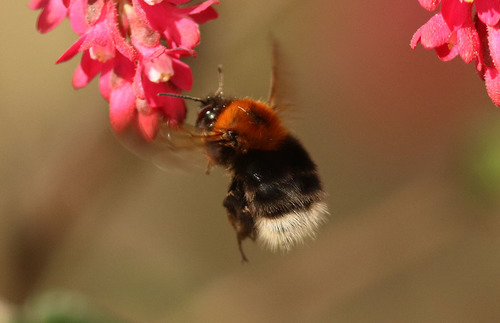
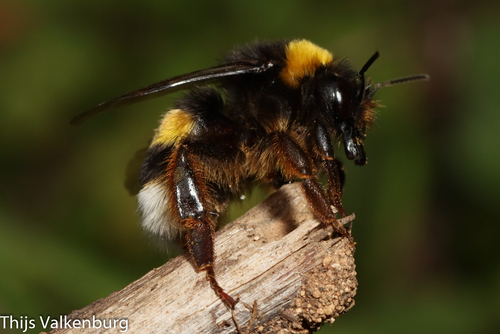
Description and identification: Bombus terrestris xanthopus is a pollen-storing bumblebee that feeds and forages on nectar and pollen. Queen bees are 20 to 22 mm long, males are 14 to 16 mm long, and workers are 11 to 17 mm long. Workers have white-tipped abdomens, and closely resemble workers of the related white-tailed bumblebee B. lucorum; the only difference when compared directly is that B. terrestris workers have darker yellowish bands. B. terrestris queens have a characteristic buff-white abdomen tip, or 'tail', while B. lucorum queens have a white abdomen tip matching the workers of that species. Unlike other bees, B. terrestris worker castes show wide size variation: worker thorax lengths range from 2.3 to 6.9 mm, and worker masses range from 68 to 754 mg. Distribution and habitat: B. terrestris is most commonly found across Europe, in temperate climates. It can survive in a wide range of habitats, so it also has populations in the Near East, Mediterranean Islands, and Northern Africa. It was introduced as a greenhouse pollinator to non-native regions, and has since escaped captivity, making it an invasive species in many of these areas including Japan, Chile, Argentina, and Tasmania. Nests are typically located underground, such as in abandoned rodent dens. Colonies create comb-like nest structures with egg cells that each hold several eggs, and the queen lays egg cells stacked on top of each other. On average, colonies produce between 300 and 400 bees, with wide variation in the number of workers. Life cycle: A solitary queen that has hatched from an abandoned colony starts the colony cycle after she mates with a male and finds a nest. She overwinters in this nest, then lays a small batch of diploid (female) eggs in spring. Once the eggs hatch, she tends the larvae, feeding them nectar and pollen. When the larvae finish growing, they pupate; around two weeks later, the first workers emerge, which completes the initiation phase of the colony. Workers forage for nectar and pollen for the colony and tend later generations of larvae. Workers are smaller than the queen, and usually die while foraging, killed by predators such as birds or robberflies. Most workers forage within a few hundred meters of their nest, though their foraging range and frequency depend on the quality and distribution of available food. After a variable length of this initial phase, a switch point occurs: the queen begins laying unfertilized eggs that develop into males. When male drones leave the nest, they do not return, and only forage for themselves. They seek out newly emerging queens to mate with. The remaining diploid eggs hatch into larvae that get extra food, then pupate to become new queens. The queen can use pheromones to discourage workers from investing more in these larvae, which ensures not too many develop into queens. The resolution of this worker-queen conflict can be complex. In temperate zones, the colony lasts until fall, when workers begin laying unfertilized eggs that will mature into males. At this point, open aggression breaks out among workers and between the queen and workers. This predictable time point occurs around 30 days into the colony cycle in very temperate climates. Usually, worker-queen conflict forces the queen out, leaving the colony queenless, and a 'false queen' may take control of the colony for a short time. Newly emerged queens may sometimes act as workers to help raise another brood of queens. During this period, they leave the nest daily to find food, and may mate during this time. Eventually they find a site to dig a 'hibernaculum' where they hibernate until the next spring, when they emerge, find food to build up their ovaries, and soon search for a site to start a new nest. In warmer climates, they may skip the hibernation stage. The old colony almost always dies out completely, and if the site is free of parasites, one of the new queens will return and reuse the site. Commercial use: Since 1987, B. terrestris has been commercially bred for use as a pollinator for European greenhouse crops, particularly tomatoes — this task was previously done by hand. B. terrestris has been commercially reared in New Zealand since the early 1990s, and is now used in at least North Africa, Japan, Korea, and Russia. The global trade in B. terrestris colonies likely exceeds 1 million nests per year. In Korea, some people prefer Bombus ignitus over the already established commercial pollinator B. terrestris, due to concerns about competition or genetic contamination from mating with native bumblebee species. There is also a ban on importing B. terrestris into North America, which has led to higher interest in other species such as B. impatiens in that region. Even so, B. terrestris is a key commercial pollinator in Europe, which has led researchers to study how agricultural land affects the foraging and survival of this species. Monoculture lowers biodiversity in farmland, and likely reduces the number of flowering species available for bees to forage on. As a result, B. terrestris has greater nest growth in suburban areas than in farmland, because local suburban gardens support more plant diversity for bees to feed on. Agriculture has a profound impact on many bumblebees, and is causing widespread decline in multiple species. However, B. terrestris remains widespread, likely because it can forage over very long distances, making it less sensitive to changes in biodiversity and the environment.