About Bombus ternarius Say, 1837
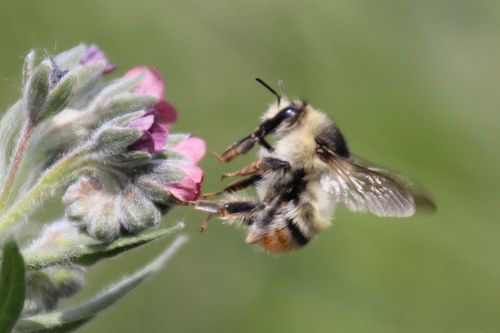
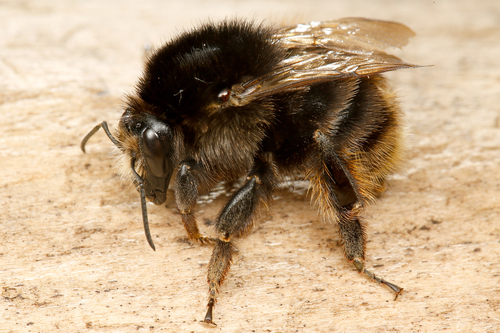
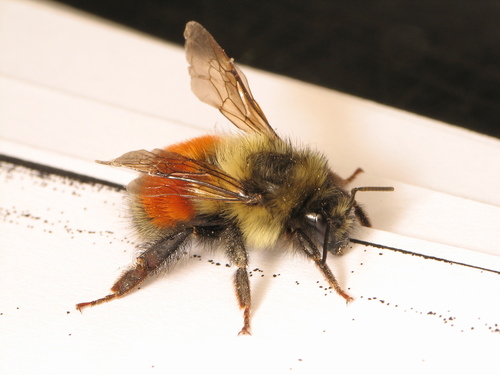
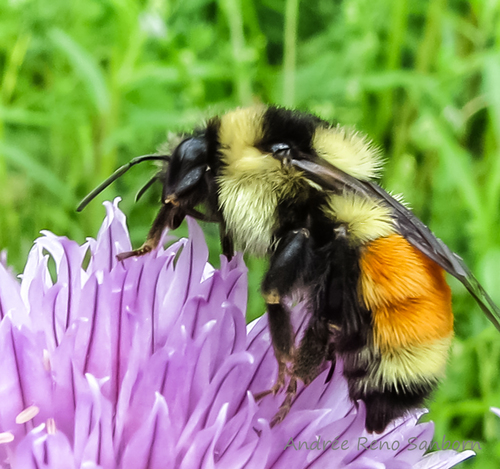
Bombus ternarius, commonly called the orange-belted bumblebee, is a small, fairly slender species of bumblebee. Size varies by caste: queens measure 17–19 mm (0.67–0.75 in) in length, with an abdomen breadth of 8.5–9 mm (0.33–0.35 in); workers measure 8–13 mm (0.31–0.51 in) in length; drones measure 9.5–13 mm (0.37–0.51 in) in length. Both worker and drone abdomens are 4.5–5.5 mm (0.18–0.22 in) in breadth. Queens and workers have black heads with a small number of pale yellow hairs. On both castes, the anterior and posterior thorax, plus the first and fourth abdominal segments are yellow; abdominal segments 2 through 3 are orange; and the terminal abdominal segments are black. Queens and workers look very similar; the most notable difference between them is the amount of fat deposits in their bodies. Workers have very little fat, especially in the abdomen, which leaves ample space for the honey stomach — an enlargement of the esophagus that stores nectar during foraging trips. In contrast, the abdomen of young queens is mostly filled with fat, making queens heavier for their size than workers. Drones have yellow heads with a few black hairs. Their thorax and abdomen coloration is similar to that of females, with the exception that the last abdominal segments are yellow along the sides. Drones also have longer fur than females. B. huntii, another bumblebee species common across the western United States, is nearly identical in coloration to B. ternarius, though B. huntii has primarily yellow facial hairs rather than the black facial base seen in B. ternarius. B. ternarius ranges primarily across the northern parts of the United States and most of Canada. Its Canadian range extends from Yukon to Newfoundland and Labrador and British Columbia. In the United States, its territory reaches from New York and Pennsylvania west to Michigan, Washington, Wyoming, Utah and Montana. This species thrives best in northern temperate climates, though it is rarely found further south. Like most bumblebee species, B. ternarius has a seasonal life cycle. Queens emerge from hibernation in late April to found new colonies. Workers are active from May through October, after which the entire colony dies except for newly mated hibernating queens that restart the cycle the next year. Drones only serve one biological function: reproduction. They fly along a fixed circuit, and deposit pheromone on prominent surfaces such as tree trunks, rocks, and posts to attract newly emerged queens. A receptive new queen follows the pheromone trail to mate with the male. Mating for B. ternarius typically occurs on the ground or within vegetation. The male mounts the female by grabbing her thorax; the queen then extends her stinger, and the male inserts his genital capsule. Mating duration varies widely, ranging from about 10 to 80 minutes total. Sperm is transferred within the first two minutes of copulation. Both individuals are vulnerable to predators while mating. After sperm transfer is complete, the male secretes a sticky substance that hardens into a mating plug, which blocks additional sperm from entering for approximately three days. This prevents other males from impregnating the same queen and competing to fertilize her eggs, reducing competition and increasing the first male's evolutionary success. Individual B. ternarius colonies use slightly different reproductive strategies. Roughly half of all queens use an early switching strategy that produces mostly male drones, while the other half uses a late switching strategy that produces mostly new queens. As a result, the female-to-male sex ratio of B. ternarius differs from the standard 3:1 ratio for Hymenoptera predicted by the haplodiploidy hypothesis, and is instead closer to an even 1:1 ratio. One hypothesis for this deviation from the typical hymenopteran sex ratio centers on the queen's decision-making: the queen chooses whether to follow an early switching, male-producing strategy or a late switching, queen-producing strategy, and workers have no choice but to comply with the queen's choice. Normally, workers would act to shift the colony sex ratio toward more females, but in B. ternarius doing this would reduce the workers' own evolutionary success.