About Bombus ruderatus (Fabricius, 1775)
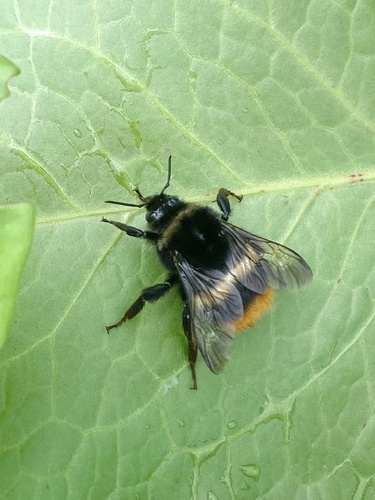
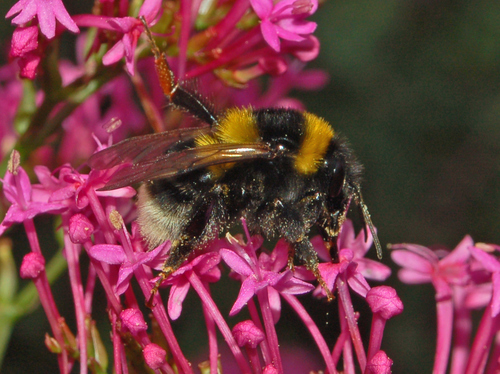
Description and identification: Queen Bombus ruderatus reach a body length of about 22 mm (0.87 in), workers reach 16 mm (0.63 in), and males reach 15 mm (0.59 in). This species has a long face and long tongue, well adapted for feeding on long-tubed flowers. Its base body color is black, with two yellow bands on the thorax—one on the pronotum and one on the scutellum—and a single thin yellow band on the abdomen. A black band between the wings separates the two yellow bands on the thorax. Queens of this species are hardest to find, as B. ruderatus is already scarce across much of its range, and queens are naturally less abundant within a colony. Distribution and habitat: Bombus ruderatus is naturally native to Europe and North Africa, where it prefers large flower-rich meadowlands that support many species of long-corolla plants. Pollen and nectar sources must be available within foraging distance of nests from April to September for this species to persist. Within Europe, B. ruderatus has been recorded in Austria, Belgium, Great Britain, the Czech Republic, Denmark, France, Germany, Italy, Poland, Romania, Spain, and Switzerland. Since the 1800s, this species has been used commercially in non-native regions to provide crop pollination. In 1885, B. ruderatus was introduced to New Zealand to pollinate red clover, and it was introduced to Chile in 1982 for the same purpose. Starting in 1993, this species has also been observed in Patagonia, Argentina; it is thought to have spread there from Chile through low-altitude areas of the Andes. Declines in native bumblebee populations have been recorded across many parts of the world, including western Europe and North America, driven by multiple factors. In Britain specifically, habitat fragmentation has caused B. ruderatus populations and pollination ranges to shrink. Bombus ruderatus often occurs in sympatry with Bombus hortorum, but B. hortorum has not been negatively impacted by fragmentation and remains relatively common in Britain. In contrast, B. ruderatus is now one of the rarest of the 25 bumblebee species native to England.