About Bombus pratorum (Linnaeus, 1761)
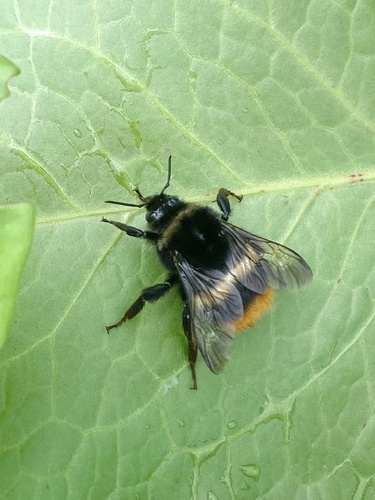
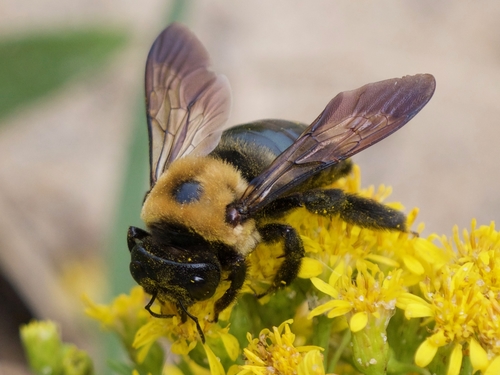
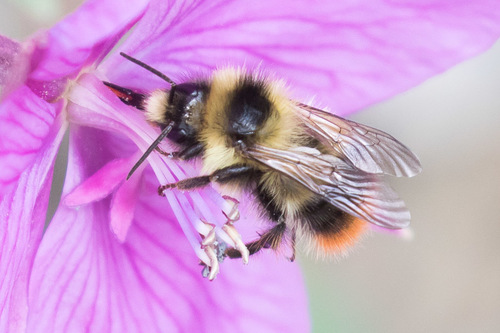
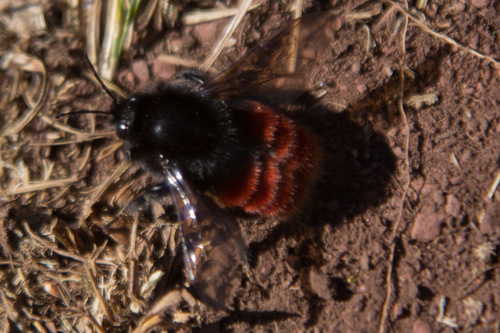
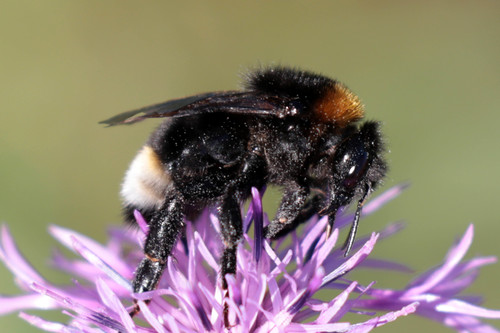
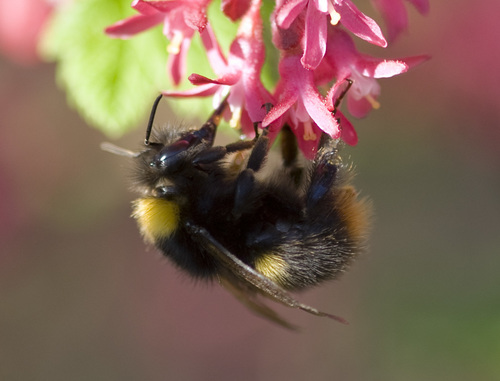
Description and identification: Queens of Bombus pratorum are black, with a yellow collar (a band across the front of the thorax), an additional yellow band on the first abdominal segment (tergite), and red colouration on the tail (the fifth and sixth terga). Males have a wider yellow collar, yellow colour on both the first and second terga, and also have a red tail. Workers resemble queens, but usually have less yellow colouration; the yellow abdominal band is typically more or less completely absent. This bumblebee has a rounded head and a short proboscis, and it is quite small in overall size. Queens measure 15–17 mm (0.59–0.67 in) in body length, workers measure 10–14 mm (0.39–0.55 in), and males measure 11–13 mm (0.43–0.51 in). Shortly after emerging, workers can be identified by a silvery colour, which quickly fades to the typical adult colouration, matching the queen's appearance with the middle yellow band missing. Distribution and habitat: B. pratorum occurs across most of Europe, ranging from the Arctic to the Mediterranean. It is uncommon in southern Iberian Peninsula, Italy, and the Balkans, and is completely absent from the steppes of southern Russia and Ukraine. In Asia, it lives in the mountains of northern Turkey and northern Iran, and is uncommon in Siberia west of the Yenisei River. It is common across most of mainland United Kingdom, but is less widespread in north-west Scotland. It is absent from most Scottish islands, including Orkney and Shetland. B. pratorum occupies a very wide range of preferred habitats, including fields, parks, scrubland, and sparse forest. It builds nests above ground, and is especially well known in the UK for using bird nests or abandoned rodent nests as nesting sites.