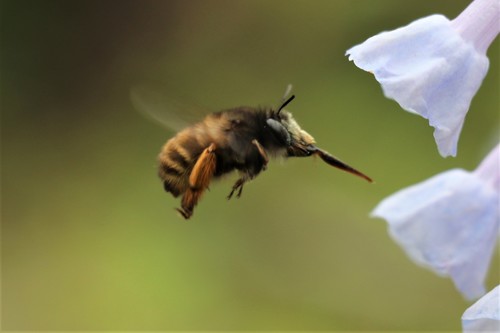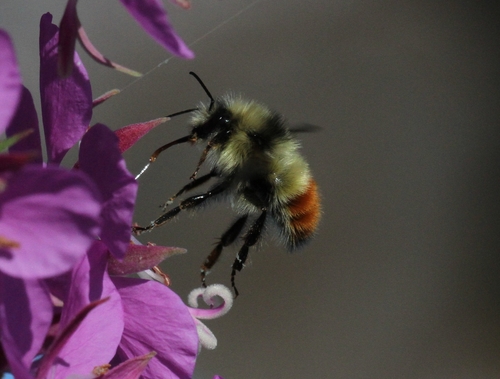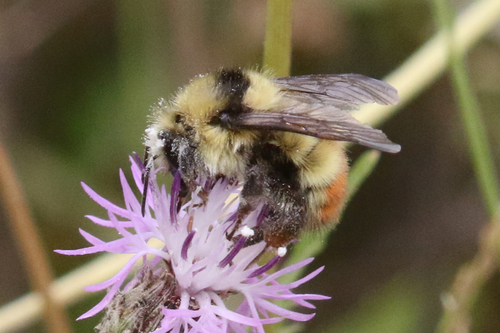
About Bombus pensylvanicus (De Geer, 1773)
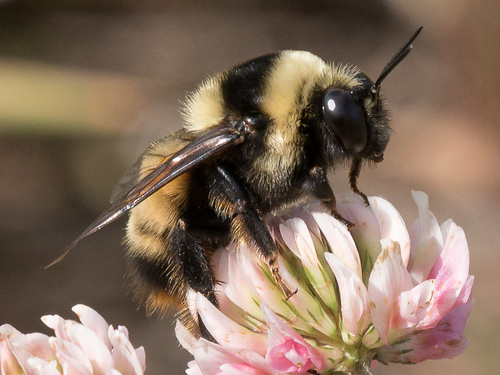
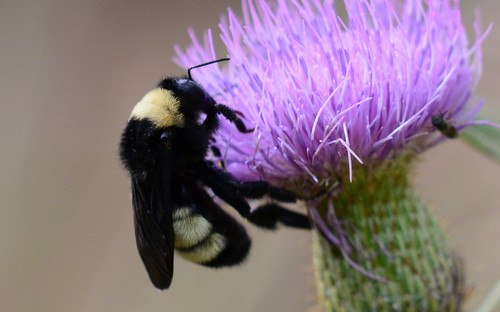
Description and identification: Bombus pensylvanicus is a widespread, long-tongued bumblebee species. Compared to its closest relative B. sonorus, it is paler yellow and has a different yellow and black banding pattern. Specifically, it has yellow hairs on the pronotum, and usually has a black scutellum, which sometimes has a mix of yellow and black hairs. Abdominal tergites T2 and T3 are yellow, as is the posterior portion of T1. It has a long, lanky malar space. These characteristics match those of B. fervidus and B. auricomus, which often leads to confusion between these species. Within a colony, queens are larger, measuring 22–26 mm, while workers measure 13–19 mm. Males have an outward-projecting penis valve head shaped like a broad banana, and often have extensive yellow coloring on the posterior thoracic dorsum that extends beyond abdominal tergite T3. While these bees normally forage close to their nests, individuals have been observed returning from distances up to 1.5 miles away. There is likely individual variation in homing ability and in the time it takes an individual to find its way back to the nest. Because return travel times vary, the method these bees use to return to the nest is most likely trial and error, rather than a sixth sense or dedicated homing instinct. Males become more common in late summer.
Distribution and habitat: Bombus pensylvanicus occurs in a range extending from the Eastern Great Plains through eastern and central United States, into southern Canada, and into Mexico. The species has become rarer, with the largest population declines occurring in the northern portions of its range. B. pensylvanicus generally nests in long grass fields, but may sometimes nest underground. It uses bundles of hay or long grass to build sheltered nests above ground. Some individuals nest in existing crevices and burrows, such as old bird nests, rodent burrows, and cinder blocks. This species has even been recorded nesting in human-made objects such as buckets and barns.