About Bombus monticola Smith, 1849
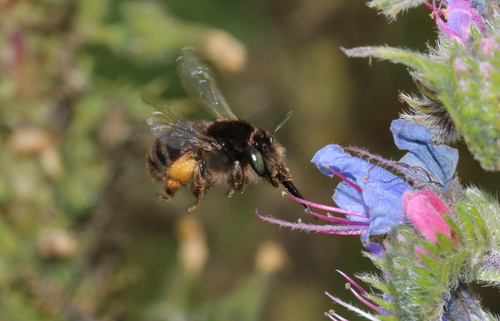
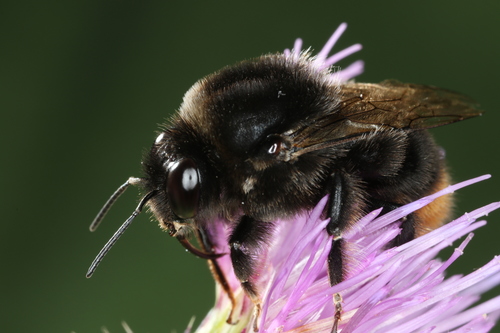
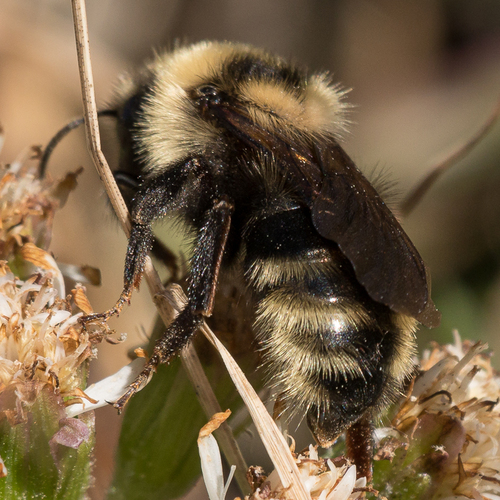
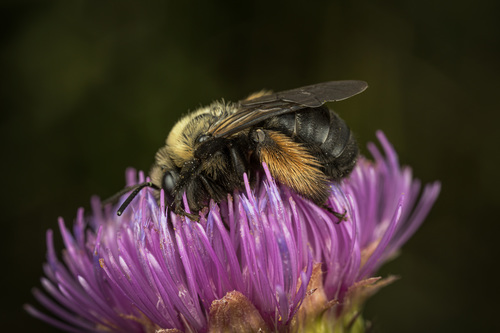
Bombus monticola, commonly known as the bilberry bumblebee, is a small, compact bee with a broad head and short tongue. Average body measurements by caste are: queens 16 mm (0.63 in) long with a 32 mm (1.3 in) wingspan, workers 12 mm (0.47 in) long, and males 14 mm (0.55 in) long. For the nominate subspecies, the thorax is primarily black, with a yellow collar that is quite broad on males, and yellow marking on the edge of the scutellum. The first abdominal tergum, the front portion of the second abdominal tergum, and the final abdominal tergite are black; all other abdominal segments are yellow to red.
This species occurs across most mountainous regions of Europe, including northern Scandinavia (mostly Norway and northern Sweden; in Finland its distribution is patchy and limited to areas along the Norwegian border), the Alps, the Cantabrian Mountains, the Pyrenees, the Apennines, and the Balkans. It can also be found in lowland habitats of northern Norway and the Kola Peninsula, as well as on the British Islands. In Britain, it occupies upland habitats, primarily moorland, with major populations located on Dartmoor, Exmoor, the Welsh uplands, the Peak District, the North York Moors, and the Scottish mainland. It was first recorded in Ireland in the 1970s, making it a recent arrival there. In Ireland, it is a montane species (the source of its scientific name monticola), and is restricted to upland areas of counties Antrim, Dublin, Wicklow, Carlow, and Wexford. Population declines in England have led Natural England to add the bilberry bumblebee to its Species Recovery Programme.
Bilberry bumblebees are typically a highland species, often associated with bilberry, cranberry, and cowberry (Vaccinium vitis-idaea). They are classified as pollen storers: instead of provisioning each larval cell with its own separate pollen store, adult bees actively feed larvae from a shared central pollen storage. They nest underground, in abandoned nesting burrows dug by small mammals. Their nests are relatively small, usually holding fewer than 50 workers, and the species' full life cycle lasts 3 to 4 months. In Great Britain, queens exit hibernation in April, the first worker generation emerges in May, and new males and new queens begin emerging in July and remain active until early October. The cuckoo bumblebee Bombus sylvestris is thought to be a parasite of this species.