About Bombus flavifrons Cresson, 1863
This is a robust bumblebee species with common name yellow-fronted bumble bee. Queens measure 13–16 mm (0.51–0.63 in) in body length with a 27–34 mm (1.1–1.3 in) wingspan. Males are 11–12 mm (0.43–0.47 in) long with a 25–26 mm (0.98–1.02 in) wingspan, while workers measure 9–12 mm (0.35–0.47 in) in length and have a 19–27 mm (0.75–1.06 in) wingspan.
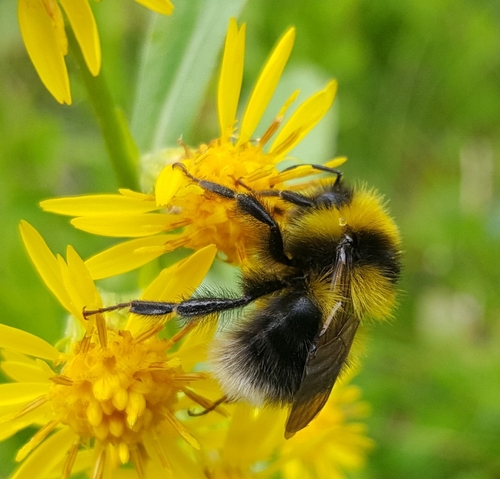
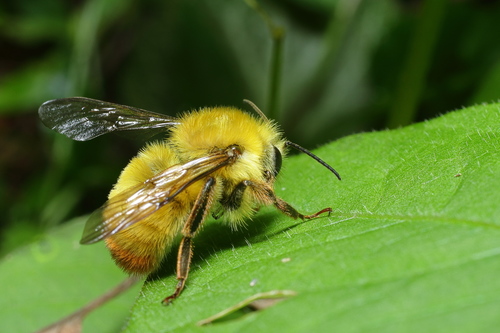
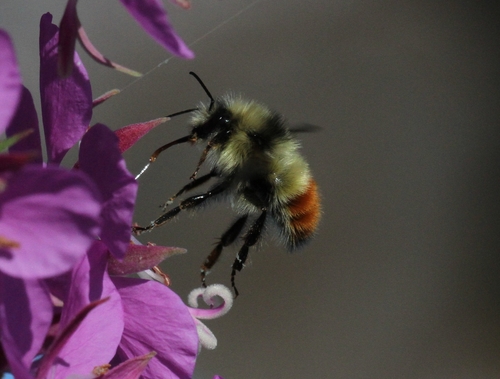
This species has dense, unkempt fur. The head is mostly yellow, with interspersed black hairs on the posterior section. The thorax has a mixed pattern of black and yellow coloration, and it often bears a central black field, which is always present in queens. The first two abdominal segments (terga) are yellow; in females, terga 1 and 2 frequently have an additional central black field. Terga 3 and 4 are red, and the abdominal tail is black, sometimes with yellow patches.
Two recognized subspecies exist: Bombus flavifrons dimidiatus, in which the red abdominal fur is more or less entirely replaced by black, and the nominate subspecies Bombus flavifrons flavifrons.
In terms of ecology, overwintering queens emerge from hibernation at the end of March, and often build their nests in abandoned mouse nests. The first worker individuals emerge roughly one month after the queen emerges. Nest activity declines at the end of August, and all nest inhabitants die except for newly produced queens, which hibernate in soil. This bumblebee forages on a variety of flowering plant species, most commonly from the families Asteraceae, Fabaceae, Saxifragaceae, and Lamiaceae. It is a host species for the parasitic indiscriminate cuckoo bumblebee, Bombus insularis. This species occurs at high altitude and high latitude, occupying habitats including tundra, taiga, mountain forests, and mountain meadows.