About Bombus cullumanus (Kirby, 1802)
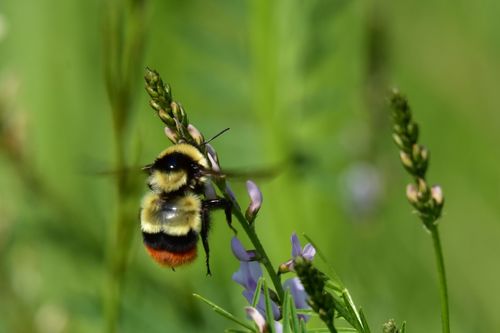
Bombus cullumanus (Kirby, 1802) has distinct physical traits by sex and caste. Female individuals, including both queens and workers, are primarily black with red tails, and yellow hairs are usually mixed in with the black fur on the collar and scutellum. Males are black overall, with a yellow face, pale coloration on the two front abdominal segments (anterior terga), and a red tail. This species was historically distributed across southern England, southern Sweden, Denmark, north-western Germany, the Netherlands, Belgium, and northern France. Its range has shrunk drastically, and it is now restricted only to the Massif Central and the Pyrenees. Some researchers argue that Bombus cullumanus is conspecific with two other Asian bumblebee species: B. serrisquama and B. apollineus. When treated as subspecies of B. cullumanus, these taxa are named B. cullumanus serrisquama and B. cullumanus apollineus respectively. B. c. serrisquama has a large but patchy distribution. Its range stretches from the steppes of northern Spain through Hungary to the northern Altai, and extends south into the steppes of south-east Kazakhstan, eastern Uzbekistan, Tadzhikistan, Kirgiztan, and Afghanistan. This subspecies was recorded in north-eastern Turkey in 1998. B. c. apollineus occurs in eastern Turkey, Transcaucasia, and northern Iran. In general, Bombus cullumanus is primarily a grassland-dwelling species. The B. c. serrisquama subspecies, however, is a mountain bumblebee that lives at elevations between 1,650 and 3,200 meters (5,410 and 10,500 feet) above sea level.