About Bombus citrinus (Smith, 1854)
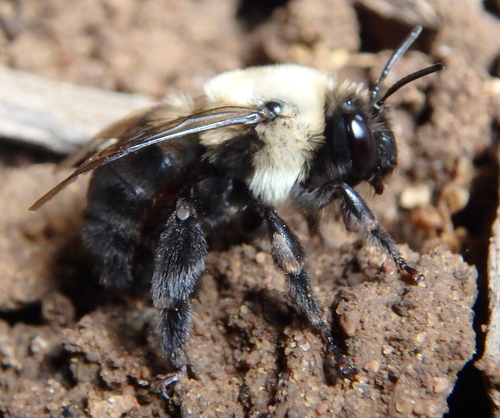
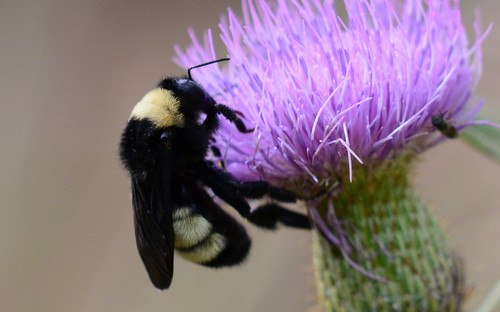
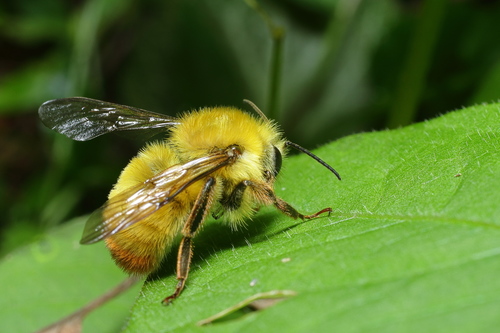
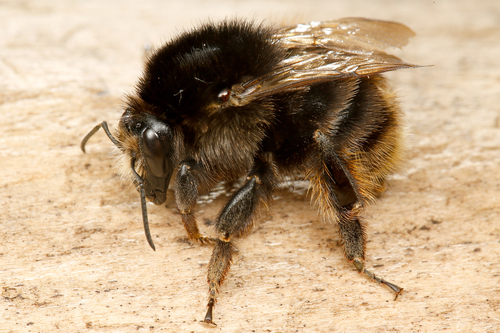
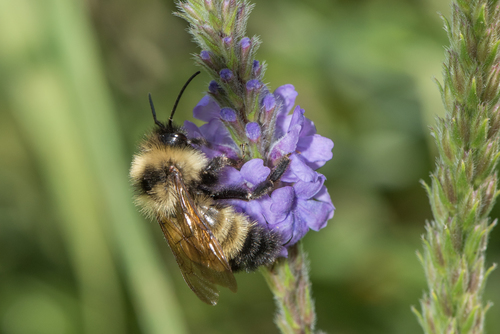
Like all cuckoo bumble bees, Bombus citrinus has a convex, densely hairy outer tibial surface on the hind leg, which is not adapted for pollen transport. Their heads are more teardrop-shaped, and the thorax is predominantly yellow, including the lower sides, with the yellow color sometimes extending down to abdominal segments T4 or T5. Hair on the face is usually black with some yellow hairs; there are typically no black hairs on the thorax, and no black band forms between the wing bases. Metastomal hairs are short and even. Hairs on T5 are longer than on the other segments, T6 is matte with dense punctures. The wings are slightly opaque, ranging in color from reddish brown to brownish black, and appear yellowish when covered in pubescence. Body hairs are sometimes interspersed with black hairs. Male genitalia hold many of the most distinguishing characteristics used to separate this bumble bee species from others. The gonostyli are lined with long hairs, while hairs on the yellow volsella are much shorter. The penis valve is long, thin, and relatively straight compared to the penis valves of other bumble bee species. Bombus citrinus is found in parts of the northeastern region of North America. Its distribution covers eastern to central Canada, northeastern U.S. states, and parts of the midwestern and southeastern U.S. When invading a host colony, B. citrinus acquires the host colony’s scent, and transfers this scent through mauling, to camouflage itself and dominate the colony. Colony recognition cues within a colony serve an important function: they enable cooperation, and help distinguish between nestmates and non-nestmates, parasites, and robbers. Many species in the subgenus Psithyrus (to which this species belongs) use scent to evade their host colony’s recognition cues. Long-chain alkanes and alkenes may possibly play a role in producing the scent used by Psithyrus bees. The Dufour’s gland is enlarged in the Psithyrus subgenus, and is thought to be the source of chemical production for bees in this subgenus.