About Bombus centralis Cresson, 1864
Bombus centralis Cresson, 1864 is a small bumblebee species with a long face, a long proboscis, and light brown wings. Members of this species have long overall body hair. Queens measure 12.5–16 mm (0.49–0.63 in) in body length, with a wingspan of 29–33 mm (1.1–1.3 in). Males measure 10–13 mm (0.39–0.51 in) in body length, with a wingspan of 22–29 mm (0.87–1.14 in). Workers measure 9.5–12.5 mm (0.37–0.49 in) in body length, with a wingspan of 23–28 mm (0.91–1.10 in).
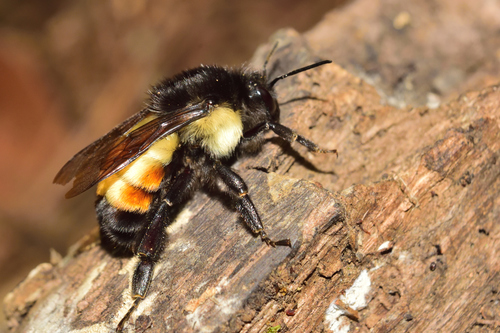
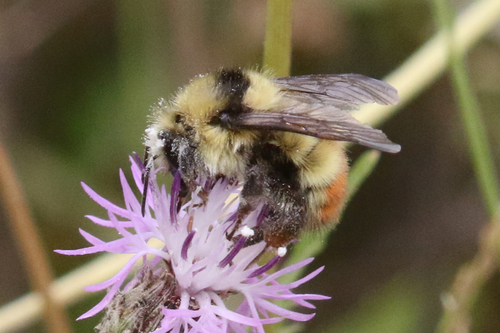
This species has distinct body coloration. The thorax and anterior portion of the abdomen are yellow, with a black band running across the center of the thorax. For female individuals, abdominal segments 3 and 4 are orange-red; for male individuals, abdominal segments 3 through 5 are orange-red. The abdominal tail is black.
Bombus centralis is distributed from the Canadian provinces of British Columbia and Alberta south to the U.S. states of California, Arizona, and New Mexico. This bumblebee inhabits prairies and river valleys. Hibernating queens emerge in late May to begin building nests, often located in abandoned rodent nests. The first adult workers emerge approximately one month after nest building begins. Nest activity declines in September, and all bees except newly produced queens die. Worker bees forage for nectar and pollen from a range of different plant groups, including wild onions, rabbitbrush, thistles, goldenbushes, coyote mints, penstemons, and phacelias.