About Bombus bimaculatus Cresson, 1863
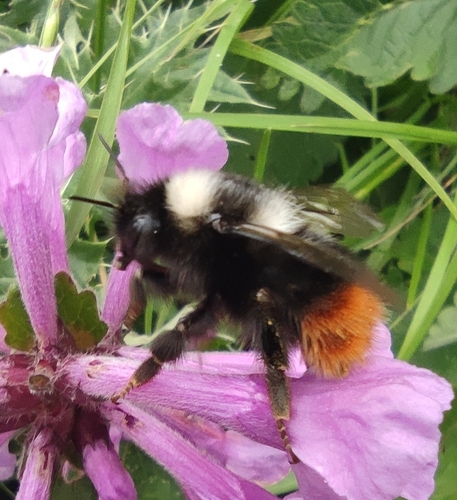
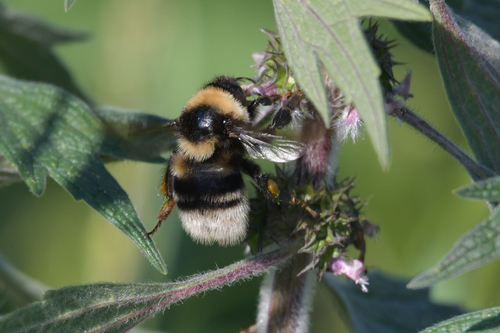
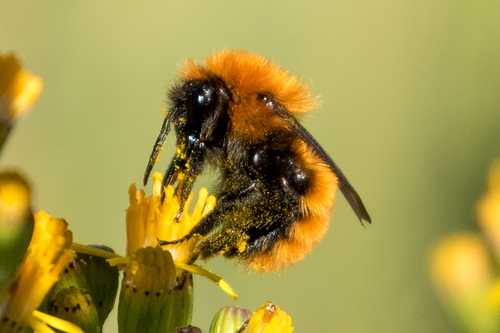
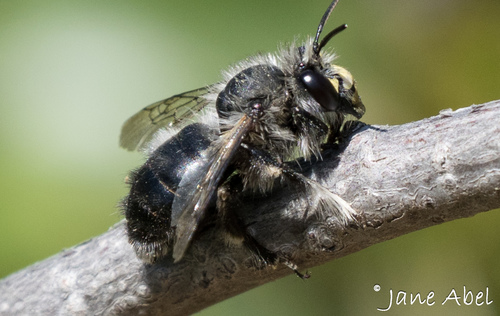
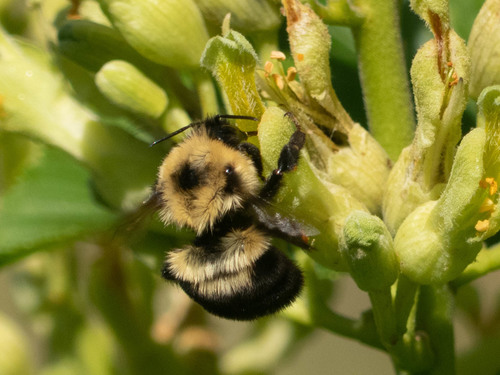
Bombus bimaculatus was first formally described in 1863 by American entomologist Ezra Townsend Cresson. Workers and queens are very similar in appearance, and are primarily distinguished by size. Late in the active season, when workers grow larger and new queens emerge, large workers may occasionally be misidentified as small queens. Queens have a black face with a triangular patch of yellow hairs on the vertex, a mostly yellow thorax with a hairless shiny central disc bordered by black hairs, and a black abdomen underside, with some yellow hairs present on their legs. Males have faces with an intermixture of black and yellow hairs. Most of their body markings match those of females, but their second abdominal tergite has more yellow hairs along its lateral edges; the female second abdominal tergite has black edges and very few yellow lateral hairs. The size of the radial cell in the wing varies across castes: workers have the smallest radial cells, measuring between 2.5 to 3.6 mm; males have slightly larger radial cells, ranging from 2.6 to 3.6 mm; queens have the largest radial cells, at 3.4 to 4.1 mm. B. bimaculatus occurs mostly in eastern temperate forest regions across the United States and southeastern Canada. It is also found in the southeastern United States coastal plains, eastern Boreal forest, and eastern Great Plains. This bumble bee builds its nests underground, and prefers locations in or near wooded areas and gardens. Underground nests sit between 6 inches and 1 foot below the surface, and access tunnels leading to the nest are 9 inches to 4 feet long. B. bimaculatus may also nest above ground or in cavities. The species does not construct its own nests, instead occupying pre-existing sites such as abandoned rodent burrows, hollow logs, appropriate man-made structures, or grass tussocks. Mated queens hibernate over winter in loose dirt or rotting logs. This is a very common bumble bee, and its population has been growing steadily, unlike the populations of many declining bumble bee species.