About Bombus affinis Cresson, 1863
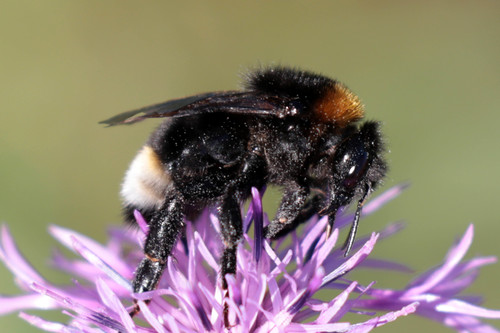
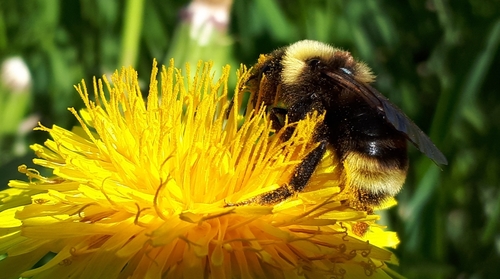
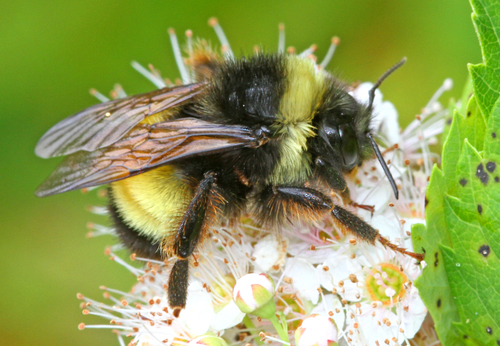
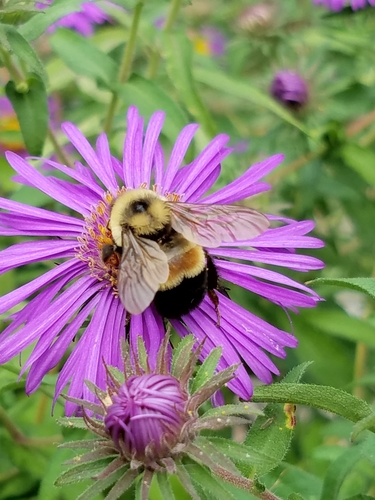
There are large morphological differences between queens, workers, and males of Bombus affinis. Queens are larger than workers, measuring 20–22 mm (0.79–0.87 in) in length and 9–11 mm (0.35–0.43 in) in width, while workers typically measure 10–16 mm (0.39–0.63 in) in length and 6–9 mm (0.24–0.35 in) in width. Both queens and workers have black hair covering the head, most of their legs, the bottom of the abdomen, and the majority of the abdomen excluding the two basal segments. Workers have a subtle mix of yellow and black hairs near the base of the wings that forms a clear 'V' shape, plus a rust-colored hair patch on the basal half of the second abdominal segment. While workers and queens share some coloration similarities, they differ in body size and in the presence or absence of these rust-colored hair patches. All colony castes of B. affinis have significantly shorter tongues than any other bumblebee species. Due to its body size and furry appearance, this bee is often confused with other bumblebee species including B. citrinus, B. griseocollis, B. perplexus, and B. vagans. Males also differ in appearance and body size from workers; they are typically slightly larger than workers, measuring 13–17.5 mm (0.51–0.69 in) in length, and have a small number of off-white or pale hairs on the tops of their heads. They also have black hair that sometimes streaks across the tops of their typically yellow abdomens, and males may even have pale yellow hair on their abdomens, unlike the standard yellow shade seen in workers and queens.
B. affinis requires three geographically close, separate habitat types for foraging, nesting, and hibernating, which makes the species particularly vulnerable to extinction. It needs a temperate climate and can tolerate colder temperatures than most other bumblebee species, and has been found at elevations up to 1600 m. Known foraging sites for B. affinis include sand dunes, farmland, marshes, and wooded areas. B. affinis forages actively between April and October, so it requires flowers that bloom over a long time period. B. affinis nests are very similar to nests of other bee species, which makes them hard to locate. Queens and workers work together to build individual cells and honey pots from stored wax. Very little information is available about B. affinis hibernating habitat. B. affinis queens overwinter, and most likely live underground or burrow into rotting logs to survive the winter.
While B. affinis habitat was once very widespread, the species has experienced a large population decline in recent years, possibly linked to increased land development and agricultural use. Until the 1980s, it was one of the most common bumblebee species in southern Ontario. Since then, its numbers have dropped drastically, and it is now difficult to find across its historic range. The last confirmed sighting of B. affinis in Ontario was recorded in 2009 at Pinery Provincial Park in Lambton County, despite extensive surveys conducted across the province. The Ontario Ministry of Natural Resources has launched a recovery project focused on protecting the species and its critical habitat centered at Pinery Provincial Park. Proposed causes of the population decline include pathogen spillover from other species, pesticide use, and habitat fragmentation and loss. Surveys carried out between 2001 and 2008 only found B. affinis populations in Illinois, Iowa, Maryland, and southern Ontario. Bell Bowl Prairie in Illinois is a confirmed habitat for B. affinis; the site was partially demolished in March 2023 to allow expansion of Chicago Rockford International Airport.