About Boltonia decurrens (Torr. & A.Gray) Wood
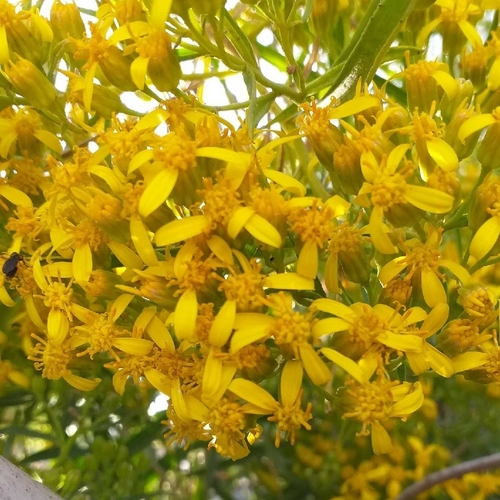
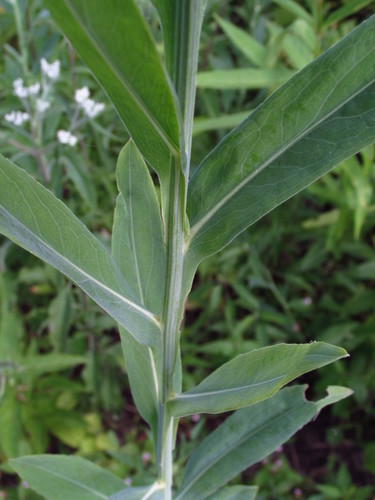
Boltonia decurrens is a rare species of flowering plant in the Asteraceae family, with common names decurrent false aster and claspingleaf doll's daisy. It is native to floodplains along the Illinois and Mississippi Rivers in the United States, where drastic habitat alteration has caused its population to decline. Historically, the species ranged across 400 kilometers of riparian forest from LaSalle, Illinois to St. Louis, Missouri. Development of the rivers and surrounding riparian habitat has fragmented its distribution into 40 to 43 separate populations. It was once believed extirpated from Missouri, but a small number of populations have been found near St. Louis since the mid-1980s. Even with overall population decline, several existing populations contain many thousands of individual plants. Population sizes are shaped by the amount and duration of annual flooding in a given area, and the species is currently a federally listed threatened species. This plant was long classified as a variety of Boltonia asteroides, until it was elevated to full species status in 1985, a rank it had held previously. It is a bushy perennial herb that can sprawl to 1.5 meters tall, and often grows taller than two meters. Its leaves are decurrent, meaning their bases extend down along the stem at the point of attachment. Leaf blades can reach up to 15 centimeters long, and are linear or lance-shaped. The inflorescence is a large panicle made up of leafy branches, with many flower heads that have white or pale purple ray florets between 1 and 2 centimeters long. The center of each flower head holds many yellow disc florets. Flowering occurs from August through October. This species can reproduce both vegetatively, by sprouting new shoots, and sexually, by producing seed. An average individual plant produces 50,000 seeds, a large total output. Seeds are dispersed by water, most often during flood events. The species is overall adapted to flooding: it has been observed growing underwater, producing an inflorescence above the water surface, blooming, and setting seed even in flooded conditions. Seeds can germinate when they land on wet substrate, and sometimes germinate while still floating on water. Today, land adjacent to the rivers is managed with widespread flood control measures, leaving few areas with natural floodplain activity. The riparian landscape has largely been converted to cropland, with original marshes and prairies drained, separated by levees, and plowed. Rivers are contained by levees, regulated by locks, and accessed via marinas. While the species is adapted to periodic natural flooding, its seedlings can only germinate and grow in clear water that allows sunlight to penetrate. Modern flooding more often produces turbid water with high silt content, a condition the species cannot tolerate. Large recent floods have deposited thick layers of silt that killed existing plants. Because natural flood disturbance is now rare, riparian areas become overgrown with brush that shades out the plants, creating the same harmful effect. In some areas, the species now relies on periodic human disturbance like mowing to clear brush, a role that severe natural flooding once filled. Population sizes depend directly on the amount of disturbance, such as flooding, that occurs in an area. Documented populations can range from just one individual to one million plants or more, and some populations may disappear temporarily. Multiple populations were observed to increase in size after the Great Flood of 1993, with the most severely flooded populations showing the greatest growth. Genetic analysis has confirmed that the species has high genetic diversity.