About Boltenia villosa (Stimpson, 1864)
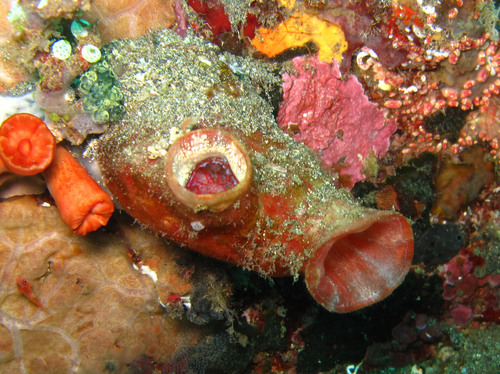
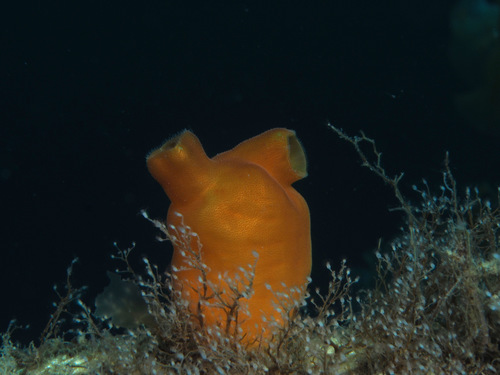
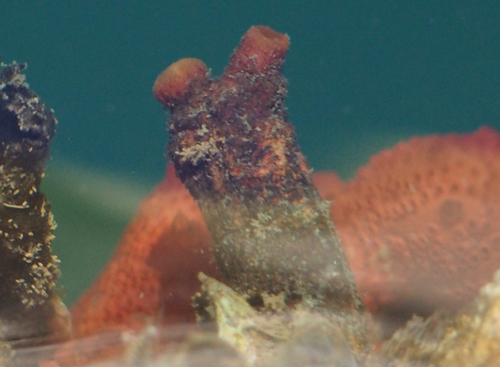
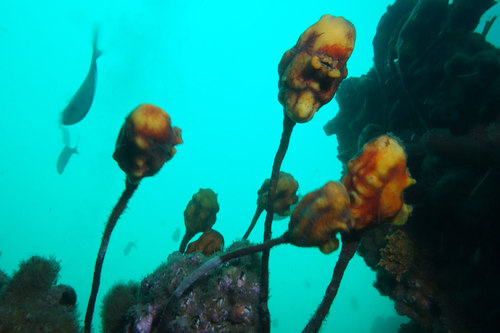
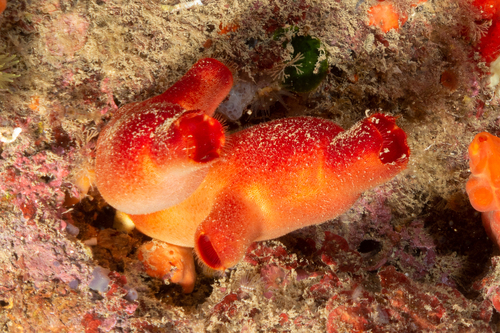
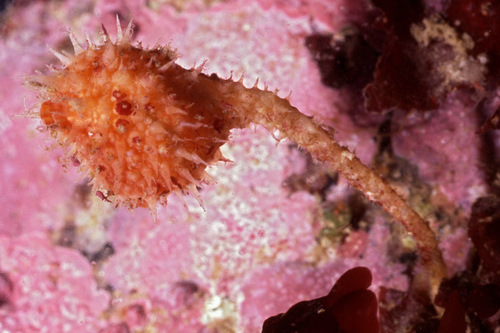
Boltenia villosa is a solitary, barrel-shaped tunicate that can grow to around 10 cm (4 in) in height and 2.5 cm (1 in) in width. It has a small base and anchors to the substrate via a stalk that can be either short or long. Its tunic is densely covered in short, bristly, unbranched projections. The siphons, which may be hard to see, are orange or red, and the tunic itself is light brown or orangish-red. This species looks similar to Boltenia echinata, which occurs in the northern Atlantic Ocean, but B. villosa’s hair-like processes are more numerous, shorter, and do not have the radial branches found on B. echinata. Boltenia villosa is distributed in the northeastern Pacific Ocean and the Arctic Ocean, found at depths from the lower intertidal zone down to about 100 m (330 ft), and inhabits both shelly and muddy seabeds. Many tunicate species accumulate vanadium in their body tissues, and B. villosa does this to a greater degree than most other tunicates. Like other tunicates, B. villosa is a suspension feeder: it draws water in through its buccal siphon, removes planktonic particles, then expels water and waste through its atrial siphon. It feeds mainly on crustacean and mollusc larvae, as well as the eggs of a variety of organisms. Small crabs or copepods sometimes live symbiotically inside B. villosa’s body cavity. Known predators of B. villosa include the Oregon hairy triton (Fusitriton oregonensis), the leather star (Dermasterias imbricata), and the rainbow star (Orthasterias koehleri).