About Boloria pales (Denis & Schiffermüller), 1775
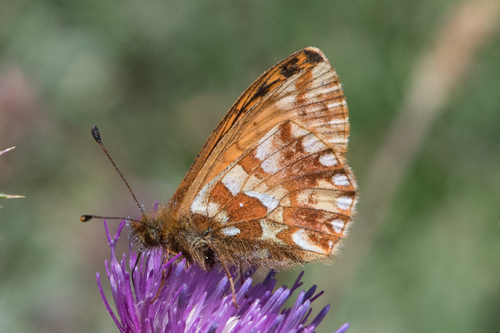
Boloria pales (Denis & Schiffermüller), 1775, originally described as A. pales in Seitz. This species is very variable: the upperside wing colour ranges from fiery red-yellow to nearly black, and markings are equally variable, with all intergrades existing between individuals that only have vestiges of black markings, and those that have such heavy, confluent black markings that the base wing colour is entirely obscured. The species can be recognized by the characteristic underside of the hindwing, and especially by the shape of the hindwing, which has a nearly straight costal margin that forms an almost right angle with the outer margin. The species is distributed across Europe, Central Asia, and Northern Asia, and is partly restricted to high mountains. In the Himalayas, it is one of the few Argynnis that extends into Indian territory; it is not found in North Africa or Japan. True pales Schiff. (67i) has a red-brown upperside with moderately heavy black markings, and is most distinguished by the forewing underside having almost no black spots, and the hindwing underside having only sparse silver markings. Occasionally the upperside is pale ochreous, this is ab. isis Hbn. (67i). The upperside may also be shaded with dark olivaceous greenish, which occurs only in females: ab. napaea Hbn. (67i). Specimens with an almost entirely black upperside that only retains vestiges of reddish yellow base colour in the outer area are ab. thales Schultz. In ab. mediofasciata Schultz, the increased black marking is limited to the median area of the wing. In ab. killiasi Ruhl, forewing markings are almost entirely absent with only slight traces remaining, but black markings on the hindwing are more strongly developed than usual, with more extended black colour at the base, disc, and along the veins. graeca Stgr., now recognized as the separate species Boloria graeca (Staudinger, 1870), was collected from the Veluchi Mountains in Greece, and was also obtained from Parnassus by Herr Kraeber. It is a rather large form, with very bright red colouring in males. It differs from typical Boloria pales in having very distinct ocelli in the outer half of the hindwing underside, and chequered fringes; its strong forewing underside markings make it somewhat similar to arsilache. Specimens from the mountains of the Balkan Peninsula, named balcanica by Rebel, now treated as Boloria graeca balcanica (Rebel, 1903), are transitional forms between typical pales and graeca. caucasica Stgr. (= arsilache H.-Sch.) (68b) is smaller in size, and males also have very bright brick-red colouring on the upperside, but are much paler on the underside. Dark markings on females of this form sometimes appear as if dusted with flour. sifanica Gr.-Grsh., now recognized as a subspecies B. pales sifanica (Grum-Grshimailo, 1891), comes from Amdo in Tibet. It only differs from caucasica in being smaller, a trait of little significance given the high variability of pales even within a single location. arsilache Esp. (= napaea Dup.) (68a) is the lowland form, and can be identified by the distinctly black-spotted underside of the forewing, where the spots are sometimes as prominent as they are on the upperside. The wing shape also differs: wings are broader and more rounded, and specimens are usually larger than alpine pales. This form occurs in North-East Europe (Russia, North-East Germany), in swamps, and along lake margins in Western Switzerland (Wallis, Waadt) and Graubunden; it is also found in Siberia. inducta Spangh. (a likely typo) is a darkened form of northern arsilache, matching the napaea form of typical pales. lapponica Stgr., now recognized as B. aquilonaris aquilonaris, was separated from specimens from western North Europe (Lapponia, Scandinavia, Belgium). It forms a connection between pales and arsilache; it is smaller than arsilache, and has diffuse markings on the forewing underside, which are only slightly more washed out than in some high Alpine specimens, and much less washed out than in individuals from East-Prussia and Russia. generator Stgr., now the separate species Boloria generator (Staudinger, 1886) (68a), has males with very bright reddish yellow upperside with very small dot-like markings, which are sometimes absent entirely from the median area. Females have whitish lunules before the outer margin. This form occurs across Central Asia. korla Fruhst., now Boloria sipora korla (Fruhstorfer, 1904) (68a), is a much larger form. Its upperside is as red as that of generator, but has a violet gloss, the wings are broad and strongly rounded, and the markings on the hindwing underside are dull and not clearly visible. It is found in Korla. eupales Fruhst., now a subspecies B. p. eupales (Fruhstorfer, 1903) (68b), is distinguished by its very brightly patterned underside, with beautiful moss-green spots alternating with cinnamon smears. Both the spots and smears are much more dentate and indented than in nymotypical pales, but silvery gloss is strongly reduced. It occurs in Tibet at 9000 ft, and is rare. palina Fruhst., now a subspecies B. p. palina (Fruhstorfer, 1904) (68b), comes from West China (Sze-chuen). It is a rather small form, where females have strong upperside markings and very little silvery gloss on the underside. The red-brown colour is greatly enlarged across all spots, bands, and dots. darjana Stgr. i. I. (68a) is even more fiery red than generator, has no markings at all in the median area, and black colour is reduced at the base of the forewing and along the abdominal margin of the hindwing. It comes from Syr-Darja. While the Central Asian forms listed above belong to the pales series, a form from Kentei sent by Herr Bang-Haas belongs to the arsilache group. Its upperside has very heavy black spotting, the forewing underside has weak spots, and the hindwing is very silvery. This form is named banghaasi form. nov., now the separate species Boloria banghaasi Seitz, 1909 (68a). At the boundary of the Palearctic Region, in the North-Western Himalayas, there are several additional forms of this widely distributed species. For example, sipora Moore (68b): its forewing, both above and below, matches that of arsilache, with abundant, quite prominent black markings. In males, spots in the middle of the forewing are thinner and sparser, while the base is very black. In females, the black colour extends so far that only the outer marginal area of the hindwing is not black. It comes from Kashmir. baralacha Moore, now the separate species Boloria sipora (Moore, [1875]) (68b), differs from sipora mainly in having sparse markings on both sides of the wings. In males, the base of the wings is barely blackened, and the hindwing underside is almost unicolorous because all different colour patches are weak and diffuse. It is also found in the North-Western Himalayas. All intergrades between these two forms exist. The larva is either paler or darker brown, with a dark dorsal line edged by light spots. It has velvety black spots in front of the spines on each segment. Dorsal spines are yellowish, lateral spines are whitish, and yellowish tubercles are found between the lateral spines. The head is black with yellowish brown eye-spots, and prolegs are reddish brown. Larvae develop from July until the following June, feeding on Violaceae. The pupa is greyish brown with blackish markings. The adult butterflies are not rare in most of their range, and alpine forms are often even abundant. Fresh males are very fiery red when in flight, almost resembling males of Melitaea didyma. They fly close along the ground in a straight, very fast flight, moving their wings rapidly up and down. They prefer to bask with their wings fully spread on warm stones. They visit a wide range of flowers, especially Composites and Calamint. The habits of arsilache from northern moors and small high-alpine pales differ in several respects.