About Boloria napaea (Hübner)
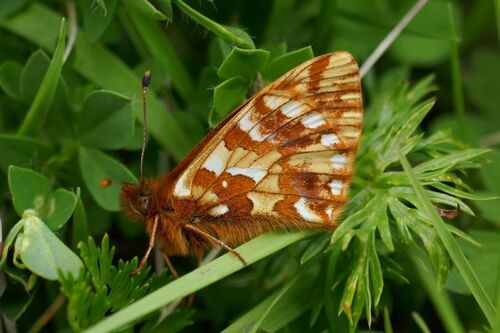
Boloria napaea (Hübner) has a wingspan of 35 to 48 millimeters. The upper side of its wings is orange with brown basal suffusion; females may sometimes show an additional purplish gray tint. The wings are decorated with brown markings, small scalloped edges, and a row of submarginal round dots. The hindwing forms an angle along its anterior edge. On the undersides of the forewings, patterns are faint, and the apex features pearly spots. The undersides of the hindwings have a clear appearance due to their prominent pearlescent markings. This butterfly flies from June to August, with timing varying by location. In Europe, caterpillars feed on Viola species, especially Viola biflora, and also on Polygonum viviparum. In North America, larvae also feed on Polygonum bistortoides. In terms of distribution, this species occurs in the Alps and mountainous areas of northern Scandinavia in Europe, with very localized populations in the eastern Pyrenees. In North America, it is found in Alaska, northwestern Canada, and in small populations in the Canadian portion of the Rocky Mountains, Alberta, and Wyoming. In Asia, it can be found in Siberia, the Altai Mountains, and Amur Oblast.