About Boloria eunomia (Esper, 1799)
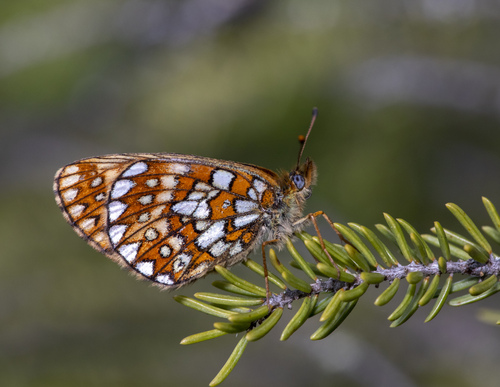
Boloria eunomia (Esper, 1799) has a forewing length of 20–24 mm. Its wings are orange brown with dark markings. The hindwings are orangish brown, with a tan postmedian band followed by a row of round silver spots. Seitz describes this species (also cited as A. aphirape Hbn. (= eunomia Esp., tomyris Hbst.) (67f)): the upperside is pale reddish yellow, with a narrow black margin and small black submarginal lunules; the basal area is separated from the central area by a black dentate line and bears heavy markings. The median area has only one very regular row of dots in the middle, and females often have faint shadows on the proximal side of this row. The proximal part of the hindwing is dull ochreous, with yellowish macular bands near the base and in the middle. The distal area of the underside of the hindwing is light yellow, with a row of small white-centred ocelli and thin hastate markings before the margin. This species can be distinguished from similar species by the underside of the hindwing: it is the only one with a row of silvery submarginal spots. Males fly close to the ground and search for females in wet areas. The flight period runs from the end of May to the beginning of August. Adults feed on nectar from flowers including Labrador tea and goldenrod. Three subspecies are recognized: triclaris, found from Newfoundland to Alberta; nichollae, found in Alberta; and denali, found in Alaska and northern Yukon. This species is listed as vulnerable, and may be threatened by changes to bog hydrology. It occurs throughout the north-temperate region of the Northern Hemisphere, including the Balkan Mountains of Bulgaria and one isolated population in Serbia. It was not recorded in Serbia at the time the Red Data Book of Serbian butterflies was published, so it is not mentioned in that work. Its common habitats are open acid bogs in moist areas; it can also be found in moist tundra and willow seeps.