About Boloria dia (Linnaeus, 1767)
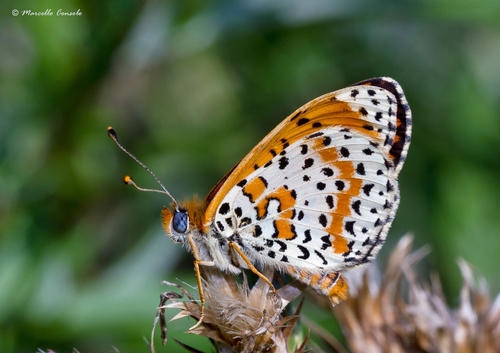
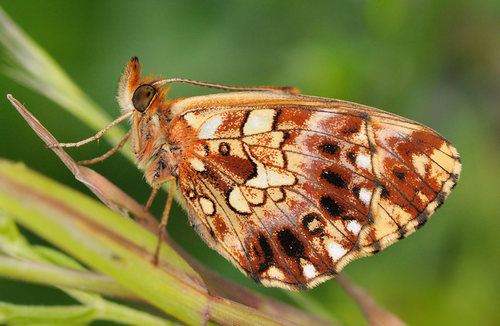
Boloria dia (Linnaeus, 1767) is a small fritillary butterfly. Adult individuals have a typically chequered orange-brown upperside, with a submarginal row of triangles and dots. The forewing length measures 16–17 mm, and the underside of the hindwing has a distinctive purplish band. In Seitz's description, this species (listed as A. dia L. (68f)) is the smallest Argynnis. The black markings on the upperside are usually more extensive than in other related species; the basal area of the hindwing is generally quite dark, and the marginal area has a row of heavy black dots. The underside of the hindwing is variegated with purple, and bears silvery spots at the margin, in the median band, and at the base. There are recorded aberrations of this species: specimens with a broad confluent median band are named ab. vittata Spul. (= mediofasciata Schultz), while in ab. hudaki Aign., an aberration especially common among the second brood, only the narrow median band of the hindwing is reddish yellow, with both the margin and the base broadly black. The subspecies B. d. alpina (originally named alpina Elw. by Elwes, 1899, 68f) is a form from eastern Central Asia, described from the Altai; its ground colour is duller, more leather-colour than reddish yellow.
The larva is paler or darker grey, with a pale-edged blackish dorsal line and a reddish brown side-line. Subdorsally, small light spots sit within a blackish patch. Its spines are pale yellow with dark yellow bases. Larvae are active in June, and from September through April, feeding on plants in the Violaceae family and Rubus, and are also reported to feed on Prunella vulgaris. The pupa is brown, with rows of small pointed tubercles on its back.
Adult butterflies fly in two broods: the first in April and May, and the second starting from August. They inhabit open areas and woodland clearings, fly low, and frequently visit flowers. At night, sleeping individuals are commonly found hanging on flowering heather; their underside is well camouflaged against heather's small flowers. Wherever this species occurs, it is not rare, but never found in large numbers.
The distribution of Boloria dia spans from Europe, across the Caucasus, east through the Palearctic realm to Mongolia. It is widespread and common across southern France. In Europe, it occurs from northern Spain, Italy, and Greece, north and east to Poland, the Balkans, and Turkey. It is not found in Britain. It also ranges across Central, Northern, and Eastern Europe, and through Anterior Asia eastward to Mongolia.