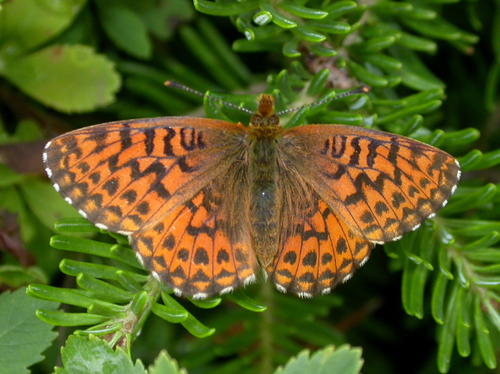
About Boloria chariclea (Schneider, 1794)
This species, Boloria chariclea, commonly called the Arctic fritillary, is a butterfly. Adults fly from July to August, with this timing varying depending on location. It has a Holarctic distribution. In Europe, it occurs in northern Lapland and Russia. In North America, it can be found in Alaska, most of Canada, the northern Cascades, the Rocky Mountains extending south to Utah and northern New Mexico, northern Minnesota, northern Maine, and the White Mountains of New Hampshire. Its typical habitats include tundra, taiga, alpine meadows, stream verges, and acid bogs. For mating, male butterflies patrol along bog edges and in valleys, waiting for females. Females lay eggs one at a time underneath the leaves of host plants. In North America, larvae feed on Viola species, dwarf willows (Salix), and possibly blueberries (Vaccinium). In Europe, larvae are believed to feed on yellow wood violet (Viola biflora) and Arctic white heather (Cassiope tetragona). Depending on location, larval development into adults takes either one or two years. Newly hatched caterpillars hibernate during the first winter, and fourth-stage caterpillars hibernate during the second winter in two-year development cycles.