About Boletus sensibilis Peck
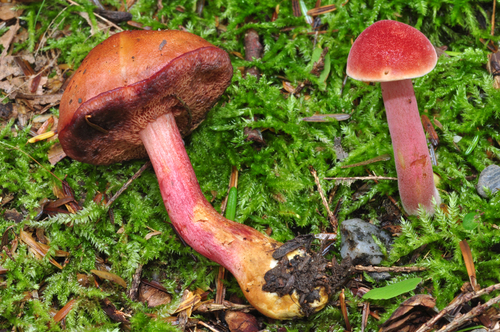
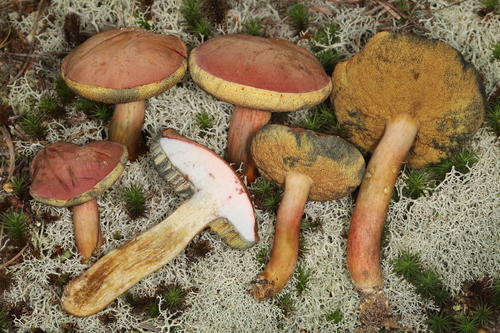
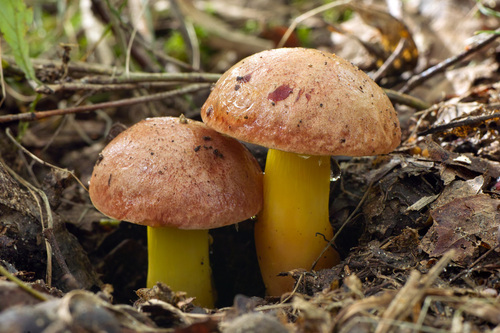
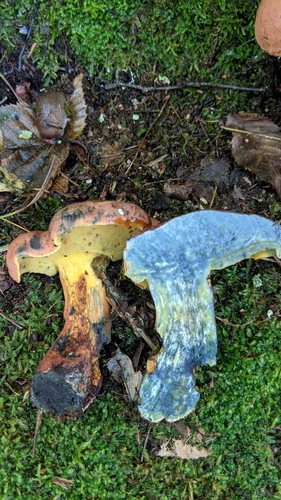
This vibrant mushroom has a stipe, or stem, that is around 5–13 cm (2.0–5.1 in) long and 2–3.5 cm (0.79–1.38 in) thick. The stipe is nearly round and has a classic club shape. Its convex cap measures 5–12 centimetres (2.0–4.7 in) across, and broadens as the mushroom ages. Young caps are dirty pinkish red, and fade to a reddish cinnamon as the mushroom ages. Perhaps the most characteristic trait of this mushroom is its near-instantaneous blue staining when handled; this feature led to the species' name sensibilis, adapted from the Latin word for sensitive. Some people describe the mushroom's smell as "curry-like", though descriptions of this smell vary. Michael Kuo has commented that the "curry-like" odor is not a distinguishing feature for Boletus sensibilis, because many collections of Baorangia bicolor have a similar smell. This mushroom forms mycorrhizal relationships with hardwood trees, and can often be found growing near oaks or beech during the summer and fall east of the Rocky Mountains. Its spore print is greyish olive. While Boletus sensibilis is commonly labeled as poisonous, some reputable sources such as mycoquebec.org consider it a choice edible, and label it "Très bon comestible". Even so, it remains one of the less well-tolerated mushrooms. Any consumption of this mushroom must be preceded by an extended boiling period of at least 15 minutes, with the temperature maintained at a minimum of 95 °C for the entire boiling time.