About Boletus reticulatus Schaeff.
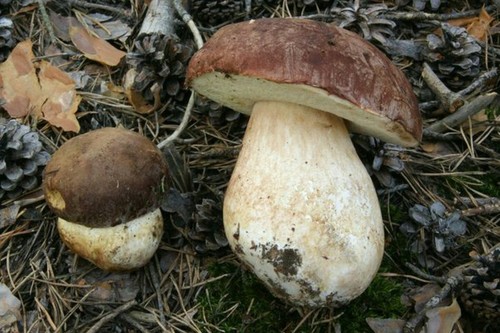
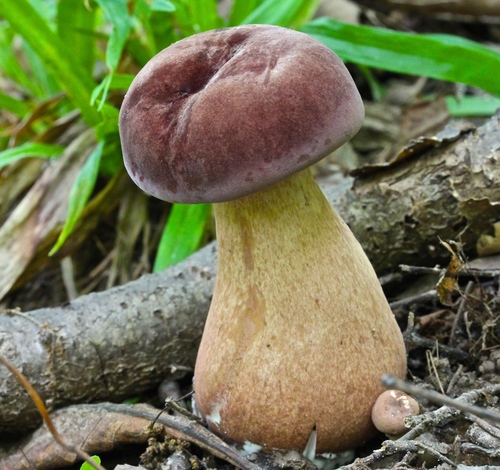
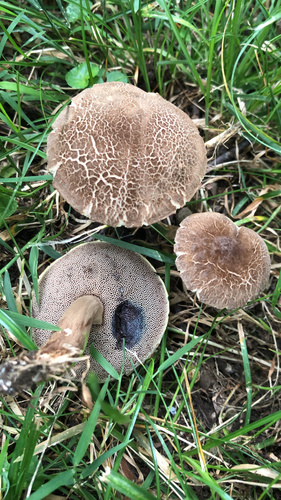
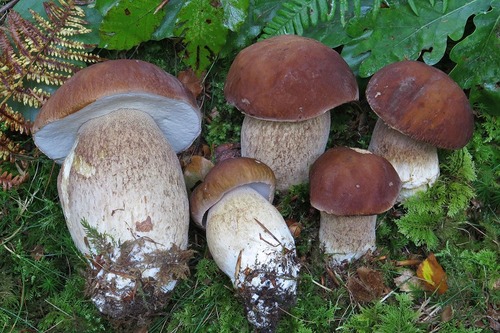
This species, commonly called the summer cep, produces a fruiting body mushroom with a large convex cap and a swollen, bulbous stem. The cap is roughly round, and typically reaches up to 30 centimetres (12 inches) in diameter. It has a velvety cuticle that ranges in color from brown through rust to chocolate. When the cuticle dries, it often cracks to reveal white flesh underneath, creating a net-like appearance. Key features that distinguish this species from Boletus edulis include its darker, more uniform cap color, velvety cap texture, and the vague or total absence of a white edge along the cap margin, which is present on B. edulis. The tubes and pores of the hymenium start out white, and darken with age to pale yellow, then finally brown. The stipe grows in the center of the cap, reaching around 12 cm (4+3⁄4 in) in height, and shows a prominent reticulated pattern. Its color ranges from white to brown, and this varies between individual mushrooms. The flesh of the summer cep is thick and white, and stays firm as the mushroom ages, though it becomes yellowish. The flesh is often consumed by insect larvae. The mushroom has a pleasant odor. In distribution and habitat, the summer cep grows in woodlands across Europe. It appears after hot and humid weather, and can be found from the beginning of summer through the end of autumn. It is especially common in the south and west of France, and in the Tosco-Emiliano Apennine in Italy. It is less host-specific than other porcini mushrooms. Within Europe, it also occurs in Ukraine and Crimea, and in Russia it is found from Republic of Karelia, Karachay-Cherkessia, Krasnodar Krai, Tula Oblast, and Moscow Oblast, extending as far east as Primorsky Krai. Boletus reticulatus has been found in southern Africa, where it was most likely introduced, growing under the Mexican pine species Pinus patula.