About Boletus chippewaensis A.H.Sm. & Thiers
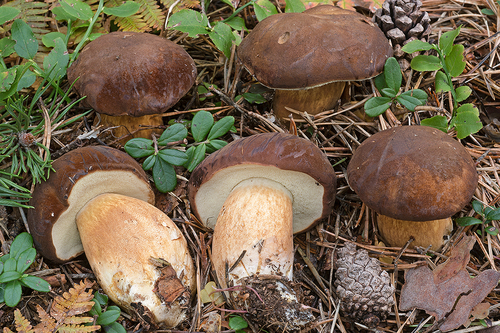
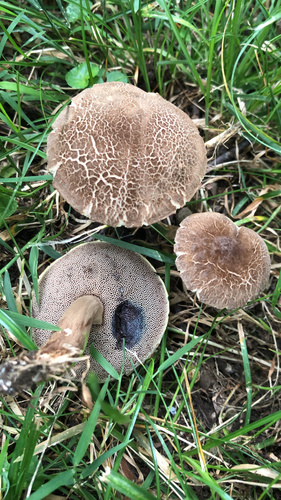
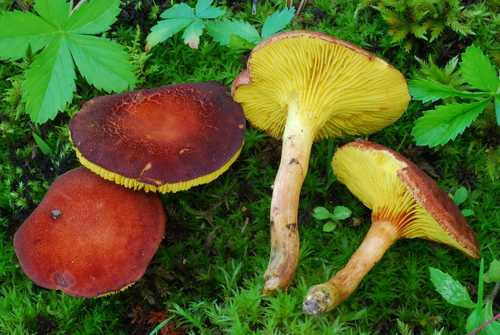
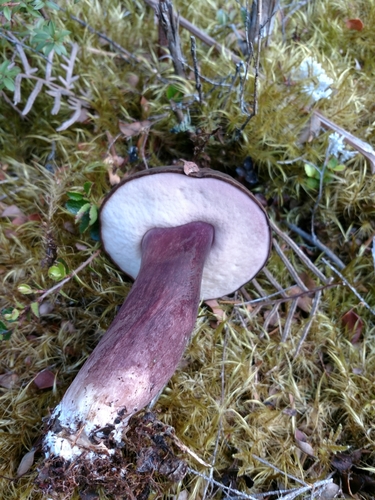
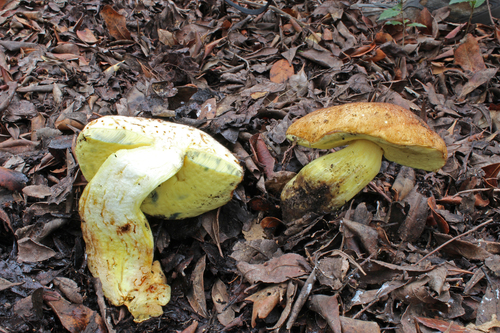
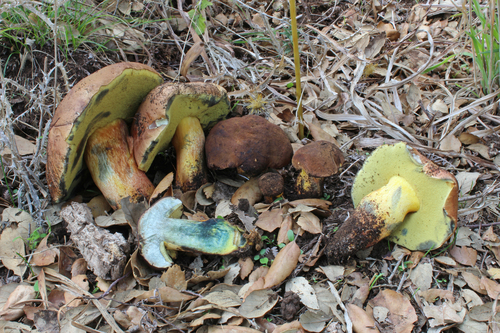
The cap of Boletus chippewaensis A.H.Sm. & Thiers reaches 8–30 cm (3–12 in) wide, and may grow larger. When moist, the cap is viscid; it is convex in young specimens and flattens as it ages. Its color is typically reddish-brown, and sometimes has a paler margin. The stipe grows 8–25 cm (3–10 in) tall and 2–7 cm (1–3 in) thick, and is rather large relative to the cap. Young stipes are usually enlarged at the base, becoming more cylindrical with age. The stipe surface is finely reticulate on its upper portion, and sometimes over the entire surface. The stem flesh is sometimes dark yellow near the base. The cap undersurface is made of thin spore-producing tubes, which are 1 to 2 cm (1⁄2 to 3⁄4 in) deep. Tubes are whitish when young, and mature to a greenish-yellow color. The small angular pores do not stain when bruised, and measure roughly 2 to 3 pores per millimetre. Young pores are white and appear cotton-stuffed (the cottony appearance comes from mycelia); as they age, they turn yellow, then later brown. The spore print is olive brown. The fruit body flesh is white, thick and firm when young, and becomes somewhat spongy with age. When bruised or cut, the flesh either does not change color, or turns very light brown or light red. Mature specimens typically weigh about 1 kg (2 lb 3 oz). One huge specimen collected on the Isle of Skye, Scotland, in 1995 weighed 3.2 kg (7 lb 1 oz); its cap was 42 cm (16+1⁄2 in) wide, and its stipe was 18 cm (7 in) tall and 14 cm (5+1⁄2 in) wide. A similarly sized specimen found in Poland in 2013 received international news coverage. Spores are elliptical to spindle-shaped, with dimensions of 12–17 by 5–7 μm. Spore-bearing cells called basidia are produced in a layer that lines the tubes, arranged with their ends facing the center of the tube; this cell layer is technically called a hymenium. Basidia are thin-walled, mostly attached to four spores, and measure 25–30 by 8–10 μm. Another cell type found in the hymenium is cystidia, larger sterile cells that protrude past the basidia into the hymenium lumen, acting as air traps to regulate humidity. B. edulis has pleurocystidia (cystidia located on the pore face) that are thin-walled, roughly spindle-shaped to ventricose, and measure 30–45 by 7–10 μm; the cotton-stuffed appearance of the hymenium is caused by cheilocystidia, cells found on the pore edges. The hyphae of B. edulis do not have clamp connections. Fruit bodies of Boletus edulis can grow singly or in small clusters of two or three specimens. The mushroom's habitat includes areas dominated by pine (Pinus spp.), spruce (Picea spp.), hemlock (Tsuga spp.) and fir (Abies spp.) trees; other host trees include chestnut, chinquapin, beech, Keteleeria spp., Lithocarpus spp., and oak. In California, porcini have been collected in a variety of forest types, including coastal forests, dry interior oak forests and savannas, and interior high-elevation montane mixed forests, up to an altitude of 3,500 m (11,500 ft). In northwestern Spain, they are common in scrublands dominated by the rock rose species Cistus ladanifer and Halimium lasianthum. In the Midi region of south-west France, they are especially favored and locally called cèpe de Bordeaux, named for the town from which they are traded to northern France and abroad. Boletus edulis has a cosmopolitan distribution, concentrated in cool-temperate to subtropical regions. It is common in Europe, ranging from northern Scandinavia south to the southern extremes of Greece and Italy, and in North America, where its southern range extends as far south as Mexico. It is well known from the Borgotaro area of Parma, Italy, where it holds PGI status. The European distribution extends north to Scandinavia and south to southern Italy and Morocco. In North America, it can be found from May to October inland, and from August to January on the West Coast. In China, the mushroom can be found from the northeastern Heilongjiang to the Yunnan–Guizhou Plateau and Tibet. It has been recorded growing under Pinus and Tsuga in Sagarmatha National Park in Nepal, as well as in the Indian forests of Arunachal Pradesh. In West Asia, the species has been reported from the northwest forests of Iran. Some progress has been made towards cultivating Boletus edulis, including mycorrhization of rockrose shrubs enhanced by helper bacteria. As the species epithet edulis (Latin for edible) indicates, Boletus edulis is an edible mushroom. Italian chef and restaurateur Antonio Carluccio described it as "the wild mushroom par excellence", and praised it as the most rewarding of all fungi in the kitchen for its taste and versatility. Considered a choice edible, particularly in France, Germany, Poland and Italy, it was widely written about by the Roman writers Pliny the Elder and Martial, although ranked below the highly valued Amanita caesarea. When served suilli instead of boleti, the disgruntled Martial wrote: sunt tibi boleti; fungos ego sumo suillos (Ep. iii. 60) which translates to "You eat the choice boletus, I have mushrooms that swine grub up." The flavour of porcini has been described as nutty and slightly meaty, with a smooth, creamy texture, and a distinctive aroma reminiscent of sourdough. Young, small porcini are most valued, because large porcini often host maggots (insect larvae), and become slimy, soft and less tasty as they age. Fruit bodies are collected by holding the stipe near the base and twisting gently. Cutting the stipe with a knife may leave a stump that rots and risk destroying the mycelium. Peeling and washing are not recommended. Fruit bodies are highly perishable, largely due to their high water content (around 90%), high enzyme activity, and the presence of microorganisms. Caution should be taken when collecting specimens from potentially polluted or contaminated sites, as multiple studies have shown that fruit bodies can bioaccumulate toxic heavy metals such as mercury, cadmium, caesium and polonium. Bioaccumulated metals or radioactive fission decay products act like chemical signatures: chemical and radiochemical analysis can be used to identify the origin of imported specimens, and for long-term radioecological monitoring of polluted areas. Porcini are sold fresh in markets during summer and autumn in Europe and Russia, and sold dried or canned at other times of the year, distributed worldwide to countries where they do not naturally occur. They are eaten raw, sautéed with butter, ground into pasta, used in soups, and included in many other dishes. In France, they are used in recipes such as cèpes à la Bordelaise, cèpe frits and cèpe aux tomates. Porcini risotto is a traditional Italian autumn dish. Porcini are featured in many cuisines, including Provençal and Viennese. In Thailand they are used in soups and consumed blanched in salads. Porcini can also be frozen, either raw or after cooking in butter. The colour, aroma, and taste of porcini deteriorate noticeably after four months of freezing. Blanching (or soaking and blanching) as a processing step before freezing can extend freezer storage life to 12 months. They are also one of the few species sold commercially as pickled mushrooms.