About Boletus auripes Peck.
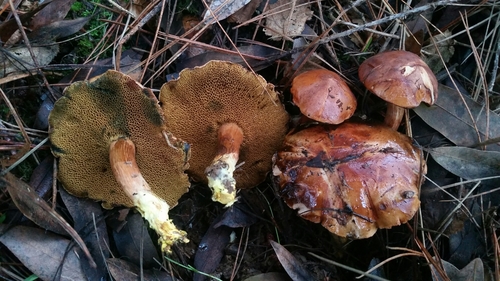
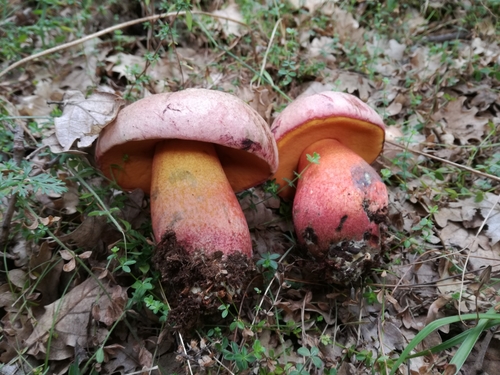
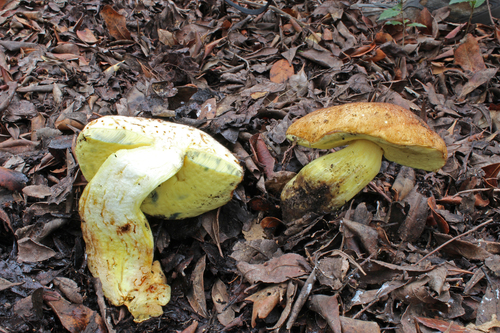
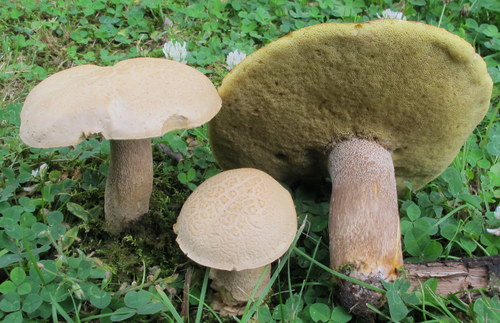
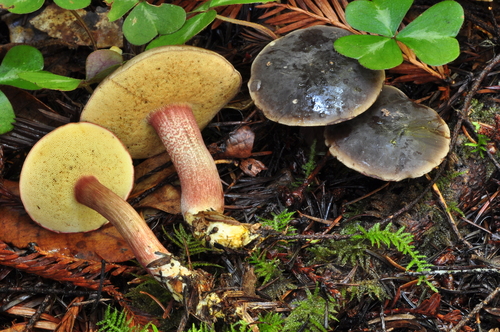
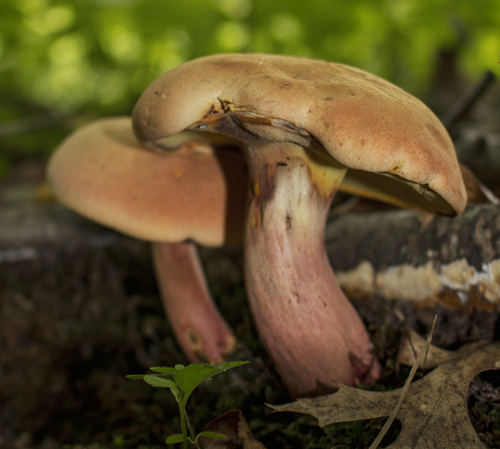
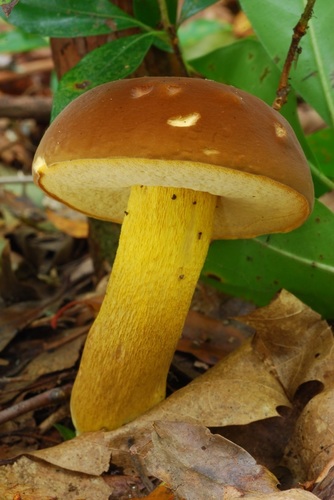
Boletus auripes Peck, commonly called B. auripes, has a convex cap that flattens slightly when it reaches maturity, reaching a diameter of 4–13 cm (1.6–5.1 in). The cap surface is dry, with a texture ranging from finely tomentose (hairy) to nearly smooth, and is colored yellowish brown to chestnut brown or grayish brown. The cap’s color fades as the mushroom ages. Similarly, the flesh, which starts out yellow, fades to whitish when the mushroom reaches maturity. Unlike many other Boletus species, neither the outer surfaces nor internal tissue of B. auripes turns blue when injured or exposed to air. This mushroom does not have a distinctive odor or taste. The pore surface starts pale yellow to yellow, and develops olive tinges as it matures; it often becomes depressed near where it attaches to the stem. Pores are circular to angular and very small, typically less than 1 mm wide, while the pore tubes are 1–2.5 cm (0.4–1.0 in) deep. The stem is golden-yellow, and measures 7–10 cm (2.8–3.9 in) long by 2–3 cm (0.8–1.2 in) thick. Young stems are usually bulbous to club-shaped, which evens out somewhat as the mushroom grows; mature stems are club-shaped to nearly equal in width along their length. The stem is dry, solid (not hollow), and has yellow reticulation, at least on its upper portion. Mycelia at the base of the stem are buff-colored. The fruit body does not have a partial veil or a ring on the stem. Boletus auripes is edible. Mushrooms produce spore prints that range from yellow brown (especially fresh prints) to olive brown. Spores are smooth and yellowish, measure 10–14 by 3–5 μm, and vary in shape from roughly elliptic to cylindric to subfusoid (somewhat spindle-shaped). The spore-bearing basidia are club-shaped, four-spored, and measure 27.2–35.2 by 9.6–10.4 μm. The cap cuticle has a cellular arrangement called a trichodermium, where the outermost hyphae emerge roughly parallel like hairs, perpendicular to the cap surface. This structure consists of erect hyphae with a diameter of 3.2–6.4 μm. Boletus auripes is mycorrhizal, and produces fruit bodies singly, scattered, or in groups growing on the ground under broadleaf trees, especially oak and beech. It has also been recorded growing in association with mountain laurel (Kalmia latifolia). It typically forms fruit bodies between June and November. Boletus auripes has a disjunct distribution, and is one of several fungal species found in both eastern Asia and eastern North America. In North America, where it is relatively common, its range extends from Alaska south to Mexico, and east to New York. It has been recorded in Belize in Central America. It has also been recorded in Taiwan, multiple regions of China (including Yunnan, Sichuan, Guangdong, Guangxi, and Hunan), and Japan. It was first reported from the Russian Far East in 2008.