About Boletellus obscurecoccineus (Höhn.) Singer
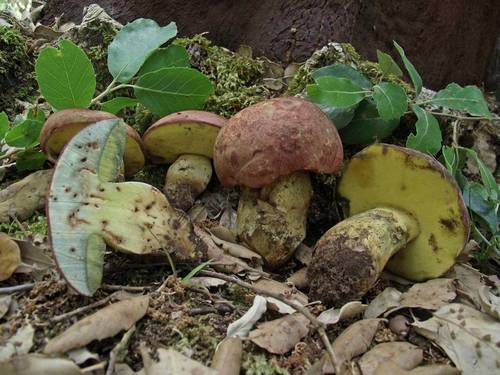
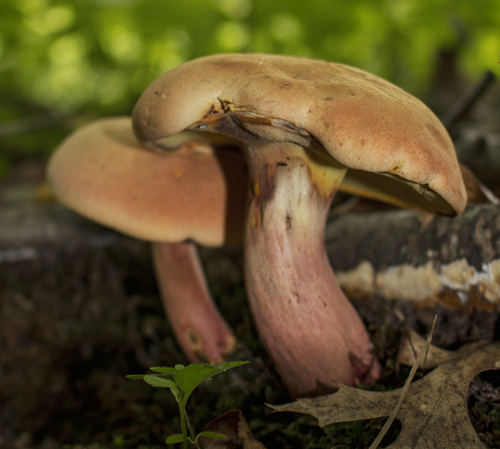
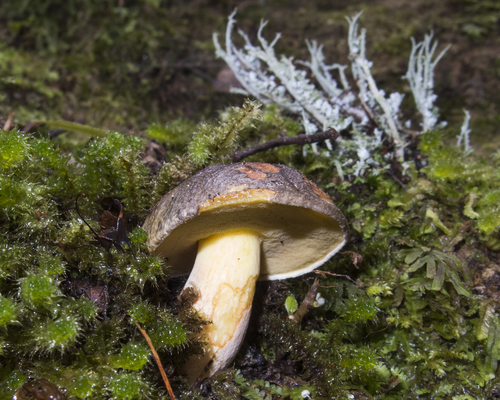
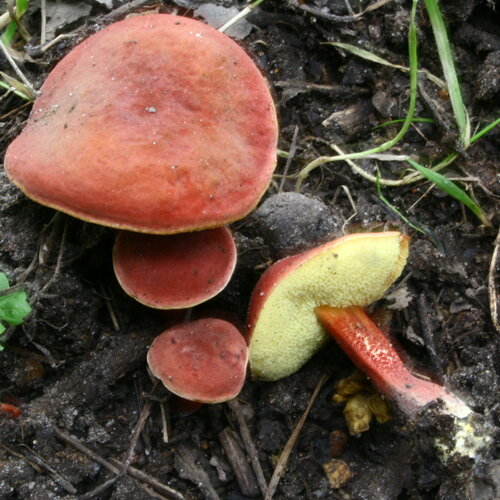
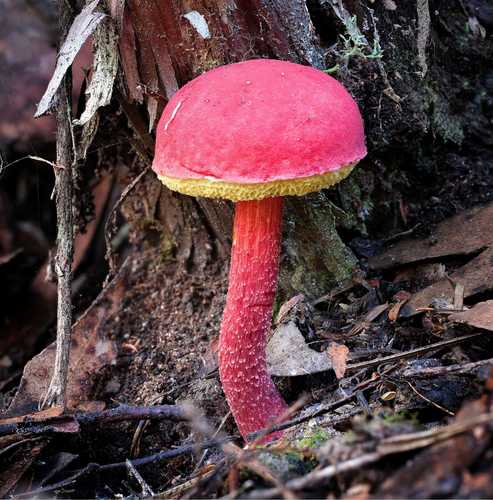
Boletellus obscurecoccineus (Höhn.) Singer is a brightly colored, distinctive bolete. It has a rose-red or rhubarb-colored cap that is hemispherical to convex in shape, reaching up to 7 cm (3 in) in diameter, with an overhanging margin when young. In older specimens, the cap may crack to reveal the yellow flesh underneath. Its adnexed pores are five- or six-sided, yellow in color, and bruise blue in some specimens, though this generally does not occur in populations found in Western Australia. The narrow stipe is ringless, growing up to 9.5 cm (3.7 in) tall and 2 cm (0.8 in) in diameter. The stipe is reddish and scaly all over, fading to yellow just below the cap. This species produces a dark brown spore print, and has white mycelium. It has no noticeable odor, and a mild taste. Under microscopic examination, its elongated pale yellow spores measure 14.5–19.5 by 6–7.5 μm. Its known distribution includes Korea, New Guinea, Java, Borneo, Japan, and Taiwan. Within Australia, the rhubarb bolete (its common name) has been recorded from southwestern Western Australia, southeastern New South Wales, Victoria, and Tasmania. Boletellus obscurecoccineus is an ectomycorrhizal species. In Australia, it grows in leaf litter in eucalyptus forests, while in Asia it associates with oak and other deciduous trees. Its fruit bodies appear during summer and autumn, from July to November. Despite its common name, it is unknown whether this mushroom is safe for human consumption. While no known inedible bolete species are deadly poisonous, many red-pigmented bolete species cause gastrointestinal distress if eaten.