About Boiga trigonata (Schneider, 1802)
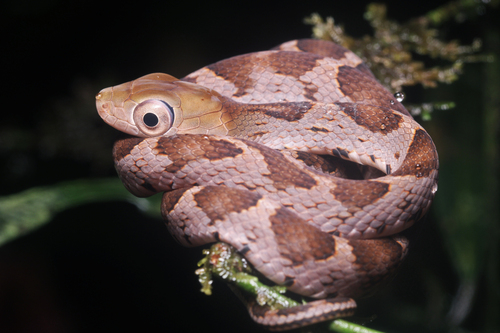
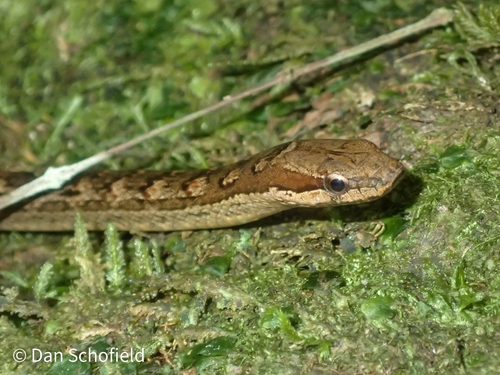
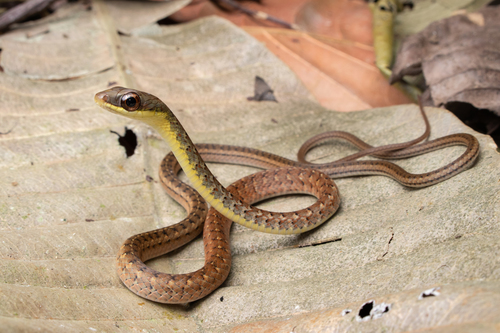
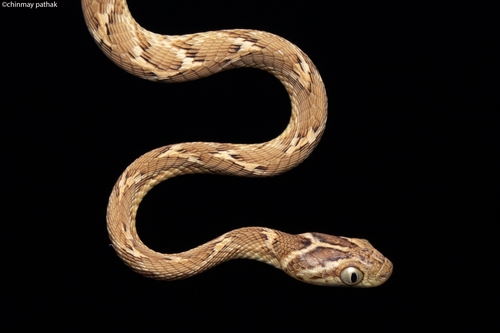
Boiga trigonata (Schneider, 1802) has anterior palatine and mandibular teeth that are scarcely larger than its posterior teeth. It has large eyes, with length equal to the distance from the eye to the nostril, and a vertical pupil. Its rostral scale is broader than it is deep, and its internasal scales are shorter than the prefrontal scales. The frontal scales are longer than the distance from the frontal scales to the end of the snout, and shorter than the parietal scales. The loreal scales are either as long as they are deep, or deeper than they are long. This species has one preocular scale that does not extend onto the upper surface of the head, two postocular scales, temporals arranged 2+3, and 8 upper labial scales, with the third, fourth, and fifth upper labials entering the eye orbit. It can have either 4 or 5 lower labial scales in contact with the anterior chin shields, and the anterior chin shields are about the same length as the posterior chin shields. The body of Boiga trigonata is moderately laterally compressed, with smooth dorsal scales arranged in 21 (or rarely 19) rows. The dorsal scales have apical pits and are disposed obliquely, and the vertebral scales are only very feebly enlarged. This species has 229–269 ventral scales, 79–92 divided subcaudal scales, and a single anal scale. The dorsal body color of Boiga trigonata is yellowish-olive or pale grey, with white zigzag markings that have black edges, and these markings may be connected. The top of the head has a distinct, pale Y-shaped mark, which is sometimes edged in black. The scales on the top of the head are large, smooth, and vary in shape. The belly is white or tan, and may have a series of small brown spots along each side. The total body length is around 3 feet (91 cm), with a 7-inch (18 cm) tail. The type locality of Boiga trigonata is the Perso-Baluchistan frontier. The species is distributed across Sri Lanka, India, Pakistan, Nepal, Bangladesh, Afghanistan (Leviton 1959: 461), southern Turkmenistan, southern Uzbekistan, southeastern Tajikistan, and Iran. The population or variant melanocephala occurs in Pakistan; this taxon is variously recognized as a subspecies, a color variant, or a full species by different sources.