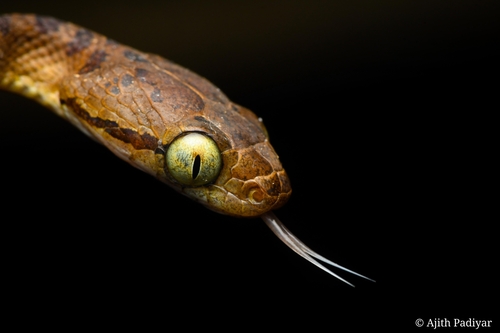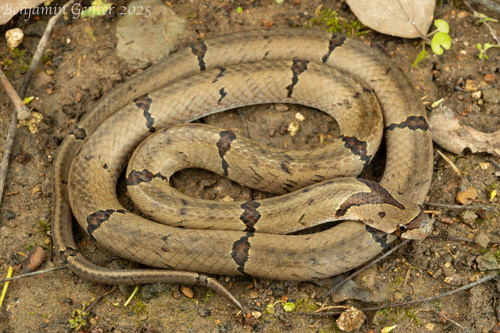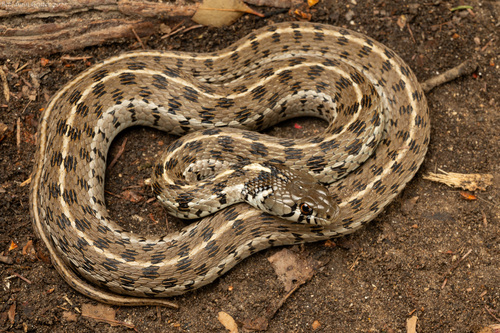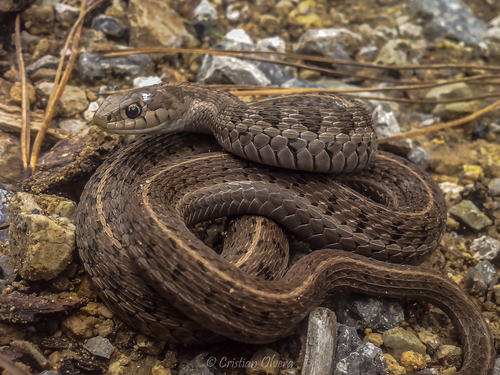
About Boiga irregularis (Bechstein, 1802)
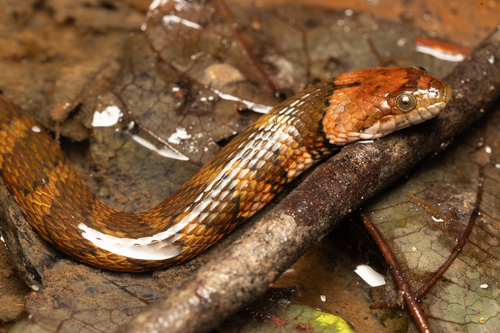
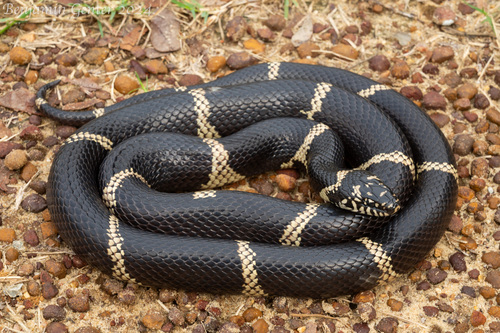
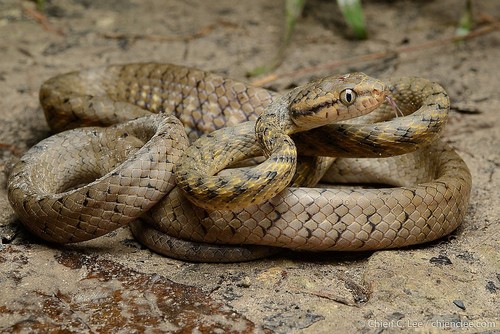
The brown tree snake, scientific name Boiga irregularis (Bechstein, 1802), is a nocturnal, arboreal species that uses both visual and chemical cues while hunting, which it does either in rainforest canopies or on the ground. It belongs to the genus Boiga in the subfamily Colubrinae; this genus contains roughly 25 species called "cat-eyed" snakes, named for their vertical pupils. In the snake's native range, adult brown tree snakes are generally 1–2 metres (3–7 ft) long. Their long, slender bodies support their climbing ability and let them pass through tiny spaces in buildings, logs, and other shaded locations where they seek refuge during daylight. In its native range, the species has wide color variation, ranging from lightly patterned brown to yellowish/green, or even beige with red, saddle-shaped blotches. Brown tree snakes are rear-fanged, have a large head relative to their body size, and can survive for long periods without food. The estimated median age at maturity is 3.1 years for males and 3.7 years for females. Due to abundant prey and a lack of predators in introduced habitats such as Guam, the species is known to grow larger than its native 1 to 2 m (3.3 to 6.6 ft) length range. The longest recorded individual of this species was a 3 m (9.8 ft) specimen found on Guam. The brown tree snake is native to coastal Australia, Papua New Guinea, and many islands in northwestern Melanesia. Its native range covers islands of varying sizes, extending from Sulawesi in eastern Indonesia through Papua New Guinea and the Solomon Islands into the wettest coastal areas of Northern Australia. The reproductive snake population on Guam is the only documented established population outside the species' native range. Since January 2016, four individual brown tree snakes have been sighted on the island of Saipan in the Northern Mariana Islands. A separate species, Boiga flavescens, was described from Sulawesi in the 19th century. Later authors recorded both B. flavescens and B. irregularis on Sulawesi, and B. flavescens was synonymized with B. irregularis in 1985 by In den Bosch. In 2021, Weinell et al. found significant genetic differences between Sulawesi and Sundaland populations, and proposed that all populations west of Weber's Line be reclassified as B. flavescens. The brown tree snake is not limited to forested habitats, and can also be found in grasslands and sparsely forested areas. In Papua New Guinea, it occupies a wide range of habitats at elevations up to 1,200 m. It is most commonly found in trees, caves, and near limestone cliffs, but regularly descends to the ground to forage at night. During the day, it hides in palm crowns, hollow logs, rock crevices, caves, and even the dark corners of thatched houses near the roof. Based on how often the species is sighted near buildings, poultry, and caged birds, it is considered common in human-disturbed habitats. Though it has been found in nearly all habitats on Guam, it is most common in primary and secondary forest there. The reproductive traits of the brown tree snake have not been extensively studied. Known female reproduction includes producing 4 to 12 oblong eggs, 42–47 mm (1.7–1.9 in) long and 18–22 mm (0.71–0.87 in) wide, with leathery shells. Females can produce up to two clutches per year, depending on seasonal climate and prey abundance. Females lay their eggs in hollow logs, rock crevices, and other sites that protect the eggs from drying out and high temperatures. Eggs hatch approximately 90 days after being laid. Unlike native Australian populations, Guam's brown tree snake populations can reproduce year-round, with no evidence of seasonal breeding restriction. Courtship behavior has been observed in brown tree snakes, with some traits that differ from other colubrine snakes. Male courtship behavior includes tongue-flicking, head-jerking, and chin-rubbing on the female before mating. If a female is receptive, mating occurs almost immediately. Notably, female brown tree snakes have been observed performing courtship behaviors previously only recorded in males, including tongue-flicking and head-jerking, and females may mount males to elicit courtship responses. When females display these behaviors toward males, males typically respond and continue until copulation. Females also use tail-lifting behavior, and release cloacal secretions in response to male courtship. Because of the brown tree snake's negative environmental impact as an invasive species, researchers have developed capture and poisoning methods to reduce its populations. Using acetaminophen, a substance to which brown tree snakes are particularly sensitive, paired with mice as bait has produced strong population reduction results in mark-recapture experiments, suggesting potential for widespread use on Guam. For studies with precisely defined treatment plots, where results were corrected for immigration and emigration, the combination of acetaminophen and mouse bait produced a 0% survival rate for brown tree snakes. In this study, 80 mg of acetaminophen was inserted into mouse carcasses. One study found that increasing spacing between traps improves efficiency without reducing effectiveness, as no difference in outcome was seen between 20-, 30-, and 40-metre perimeter trap lines; a separate study supported this finding of increased inter-trap spacing. In 2013, a large-scale field trial began, where scientists deployed these toxic mouse baits via aerial drop across two separate 55-hectare (140-acre) forest plots on Guam. A third site of the same size was left untreated as a control. Over the 16-month experiment, the National Wildlife Research Center (NWRC) tracked both snake and rodent populations to assess the baiting strategy's effectiveness and check for unintended environmental impacts. An additional aerial baiting trial was carried out in May and June 2019. Researchers selected 30 brown tree snakes for this study, surgically implanted motion-sensitive transmitters into each snake, then released them back into the area they were captured from. In the following weeks, researchers aerially distributed nearly 20,000 bait cartridges within the study plot. The study recorded 11 of the 30 tagged snakes dying during the toxin treatment period, with zero deaths during the non-treatment period. Researchers concluded that strong data supports an additive size-based treatment effect on mortality: smaller snakes experienced a larger treatment effect, but mortality probability during the treatment period was higher for all snake sizes during treatment. Further field work identified similar limitations of existing methods. When a new brown tree snake population was discovered in 2020 on Cocos Island, researchers tested various control methods including cage trapping and acetaminophen-laced carrion baits placed both on the ground and suspended in trees. Despite more than 2,400 bait nights and 10,000 trap nights, monitored with time-lapse cameras, no baits were eaten, and only one snake was trapped. These results indicate that traditional baiting and trapping methods are ineffective in this environment. Scientists attributed this failure not to low snake numbers, but to the local abundance of the species' preferred natural prey, including large geckos and birds. Because of this, researchers plan to continue manual removal efforts and test whether live bird lures may be more effective in future control attempts. Firearms are a common lethal control method for invasive vertebrates including snakes. A 2018 study conducted at the Brown Treesnake Project laboratory on Guam tested airsoft guns, a lower-cost, lower-powered alternative to traditional firearms, as a lethal control method for brown tree snakes. Using both dead and live snakes, the study recorded wound evidence, wound effects on snake bodies, and reactions of live snakes after being shot. The study found that higher-power airsoft guns firing larger ammunition are preferable for brown tree snake control.