About Boiga forsteni (Duméril, Bibron & Duméril, 1854)
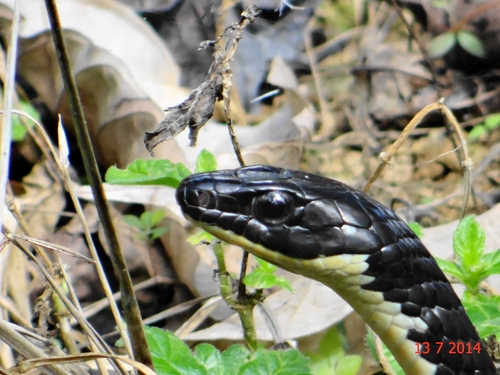
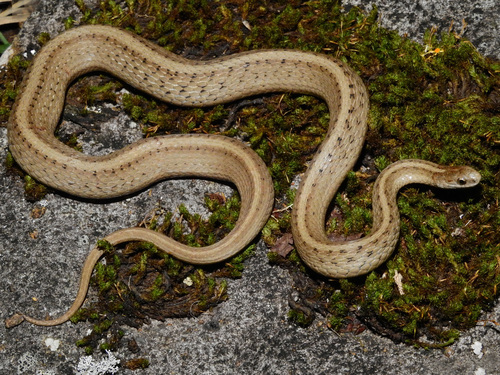
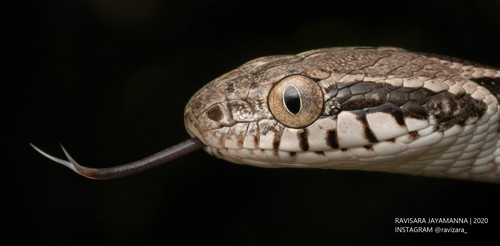
This species is scientifically known as Boiga forsteni (Duméril, Bibron & Duméril, 1854). For explanations of scale terminology referenced here, see snake scales. In B. forsteni, the anterior palatine and mandibular teeth are considerably larger than the rest of the teeth. The eye is roughly as long as the distance between the eye and the nostril. The rostral scale is broader than it is deep, and the internasals are much shorter than the prefrontals. The frontal scale is almost as long as the distance from the frontal to the tip of the snout; this distance is shorter than the length of the parietal scales. The loreal scale is square, or deeper than it is long. There is one preocular scale, which extends onto the upper surface of the head, and two or three postocular scales. Temporal scales are very small and numerous. There are 8 to 11 upper labial scales; the third, fourth and fifth, or alternatively the fourth, fifth and sixth upper labials enter the orbit of the eye. Three or four lower labial scales make contact with the anterior chin shields, which are about the same length as the posterior chin shields. There are 259 to 270 ventral scales, the anal scale is entire, and there are 106 to 131 subcaudal scales. The body is laterally compressed. At midbody, dorsal scales are arranged in 25 or 27 oblique rows, and the vertebral row of scales is weakly enlarged. The snake is brown on its upper surface, with more or less regular angular black crossbars, and may or may not have white spots between these crossbars. There is one black band running from the frontal shield to the nape, and an additional black band on each side of the head behind the eye. The underparts are white, and may be either uniform in color or spotted with brown. The longest specimen examined by Boulenger in 1890 had a total length of 4 feet 10 inches (1.47 m), which included a tail 1 foot (30 cm) long. According to Das (2002), the maximum recorded snout–vent length (SVL) is 2.3 m (7.5 ft). Boiga forsteni is found in Nepal, Sri Lanka, and India, where it occurs in Sikkim, West Bengal, Maharashtra, Gujarat, Kerala, Uttar Pradesh, Bihar, Madhya Pradesh, Orissa, Andhra Pradesh, Tamil Nadu, southern Rajasthan, Uttarakhand, and Jharkhand. This species prefers to live in lowland forests and agricultural areas. B. forsteni is an oviparous species. Sexually mature females lay clutches of 5 to 10 eggs. In India, egg laying takes place in August and September.