About Boiga dendrophila (Boie, 1827)
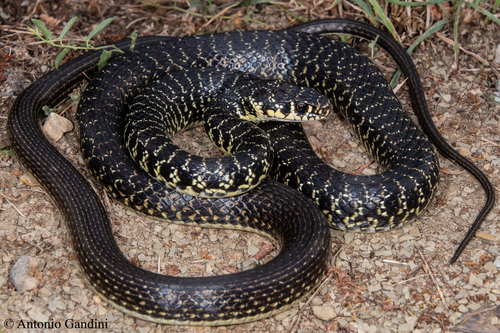
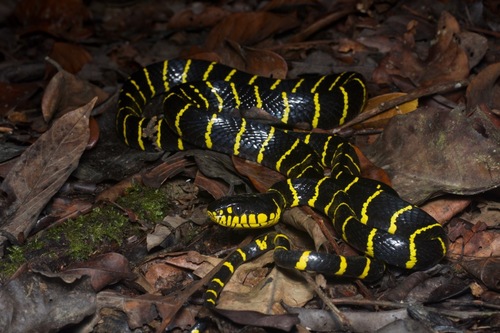
Boiga dendrophila (Boie, 1827) has the following physical and scalation characteristics. Its snout is longer than the eye; the rostral scale is broader than deep, and visible from above. The internasal scales are as long as or shorter than the prefrontal scales. The frontal scale is as long as or slightly shorter than the distance from the frontal scale to the tip of the snout. The loreal scale is at least as long as it is deep. One preocular scale extends to the upper surface of the head, and does not reach the frontal scale. There are two postocular scales. Temporal scales are arranged as 2 + 2 or 2 + 3. There are 8 (occasionally 9) upper labial scales, with the third to fifth upper labials entering the eye socket. Four or five lower labial scales are in contact with the anterior chin shields. The anterior chin shields are as long as or longer than the posterior chin shields. Anterior palatine teeth are not much larger than posterior palatine teeth. Dorsal scales are arranged in 21 (occasionally 23) rows, with the vertebral row of scales enlarged. Ventral scales number between 209 and 239. The anal scale is entire. Subcaudal scales number 89. The upper body is black, marked with yellow transverse bands that may be continuous or incomplete, not always extending fully across the back. Labial scales are yellow with black edges. The lower surface of the body is black or bluish, and may be uniformly colored or speckled with yellow; the throat is yellow. Boiga dendrophila occurs across Southeast Asia and Indochina, specifically in Cambodia, Indonesia (including Bangka, Belitung, Borneo, Java, the Riau Archipelago, Sulawesi, Sumatra), Brunei, Malaysia, Myanmar, the Philippines, Singapore, Thailand, and Vietnam. Despite one of its common names being mangrove snake, Boiga dendrophila occurs more often in lowland rainforests than in the mangrove swamps that give it this common name.