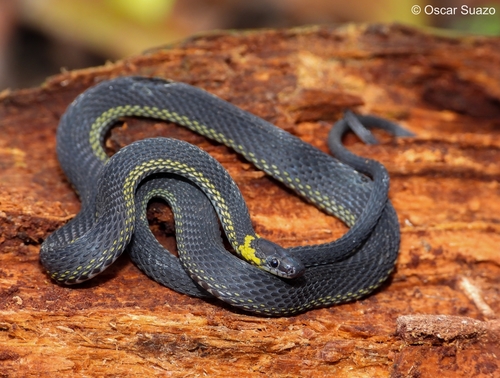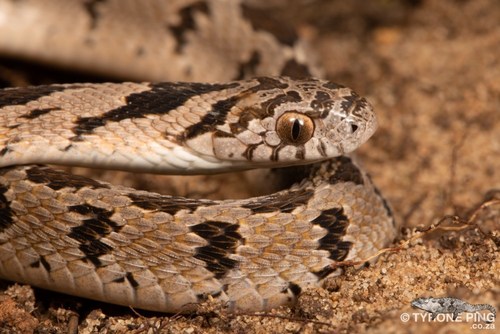
About Boiga cynodon (Boie, 1827)
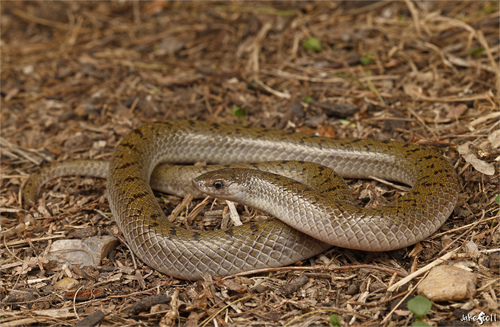
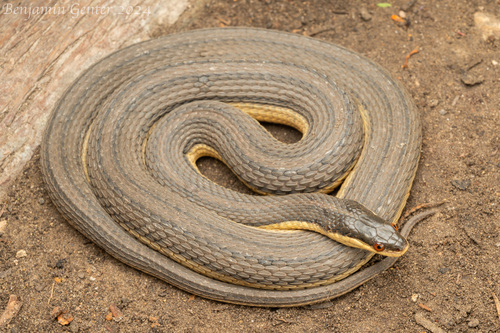
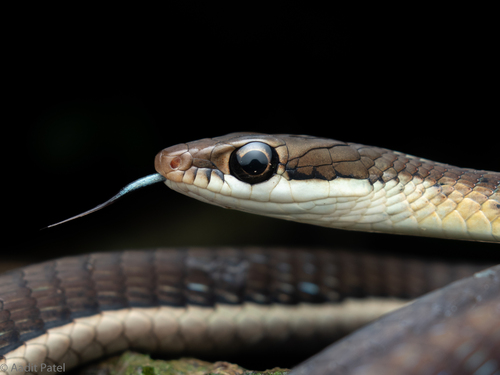
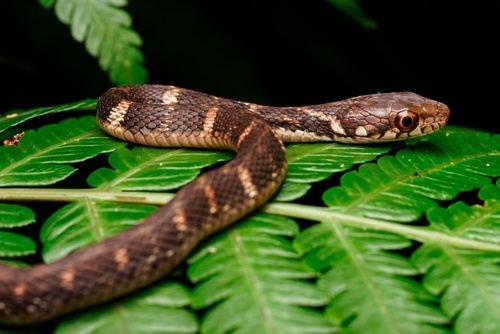
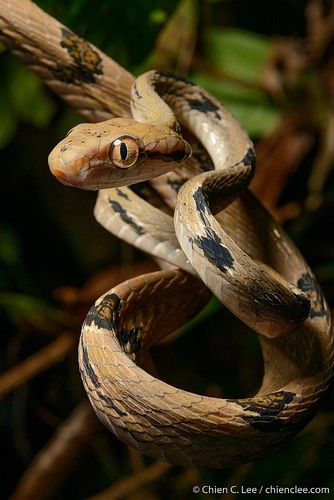
Boiga cynodon, commonly called the dog-toothed cat snake, is a large species that grows to over 2 meters (6 1/2 feet) in total length. The front teeth of both the upper and lower jaws are strongly enlarged. Anterior palatine teeth are also significantly enlarged, and the posterior chin shields are larger than the anterior ones. Its dorsal scales are smooth, arranged in 23 or 33 rows at midbody, and the scales along the vertebral row are notably enlarged. This species has 248 to 290 ventral scales and 114 to 165 subcaudal scales. B. cynodon can be distinguished from similar species by several key traits: it has a slender, laterally compressed body, and it features a distinctly wavy or irregular post-ocular stripe, unlike the more even or nearly even upper and lower post-ocular lines seen in other similar species. While its coloration can vary, it typically has yellowish or pale reddish-brown dorsal color marked with dark brown or black transverse spots or crossbars. It also has a dark postocular streak of irregular thickness on each side of the head. Its belly is yellowish, and may be uniformly colored or marbled with brown. A solid black color variation has been reported in Indonesian populations of this species. This species may have potent neurotoxic venom, but the effects of envenomation have been shown to be reversible with neostigmine, meaning envenomation from B. cynodon can be treated with anticholinesterase therapy. The dog-toothed cat snake occupies a wide range of habitats, including primary and secondary forest, cultivated areas, rural gardens, and urban areas, and it is often found in coconut plantations. In forested areas, it is known to live in the canopy. On Bali, Indonesia, this snake is relatively abundant in secondary forests and gardens, especially in areas where trees and bushes grow along rivers and streams. The presence of juveniles in these habitats suggests successful breeding occurs in disturbed areas, though it is also possible the snakes are taking refuge in the remaining patches of relatively undisturbed riverine habitats that border cultivated land. This species is known to be preyed on by the black spitting cobra (Naja sumatrana). It is also occasionally killed by vehicles, as confirmed by recorded roadkill incidents. Individuals of this species have been recorded for sale in some online groups in the Philippines. Boiga cynodon is a widespread species native to Southeast Asia. Its range extends from southern Thailand into Peninsular Malaysia (including Pulau Tioman) and Singapore, and south through Indonesia as far as Bali. Within Indonesia, it can be found on the Mentawai Archipelago, Sumatra, Nias, the Riau Archipelago, and Java. It also occurs across Borneo, including Brunei, Kalimantan, Sabah, and Sarawak, and throughout the Philippines, including the islands of Basilan, Culion, Dinagat, Leyte, Luzon, Mindanao, Palawan, Polillo, Sibutu, Panay, Samar, and the Sulu Archipelago. All records of this species from the Lesser Sundas east of Bali, including Sumbawa and Flores, actually refer to the closely related species Boiga hoeseli. In the Philippines, this species is typically found from near sea level up to around 600 meters elevation. Its presence in Myanmar is unconfirmed. The International Union for Conservation of Nature assessed this species on 30 August 2011 and listed it as Least Concern. This listing is due to its wide distribution, presumed large population, presence in multiple protected areas, tolerance of habitat modification, and apparently stable population with no known major threats. According to available data, the ex-situ (captive) population of this species totals 10 individuals: 3 males, 6 females, and 1 unsexed individual. These 10 individuals are held across two member institutions of Species360, located in two different countries. Captive individuals have also been reported by Cobra Show Thailand in Surat Thani, Thailand, the Moscow Zoo breeding nursery in Sychovo, Russia, and Tula Exotarium in Tula, Russia. Boiga cynodon is an oviparous species. Sexually mature females produce clutches of 6 to 12 eggs. The reported mean length of B. cynodon eggs is 52 millimeters, and the reported mean width is 24.6 millimeters. Eggs within a single clutch often stick to one another. Hatchlings have been observed cutting a slit in the eggshell from the inside one day before emerging from the egg. It is suspected that improper incubation temperature, humidity, or both, can cause embryo death or the hatching of juveniles with spinal deformities.