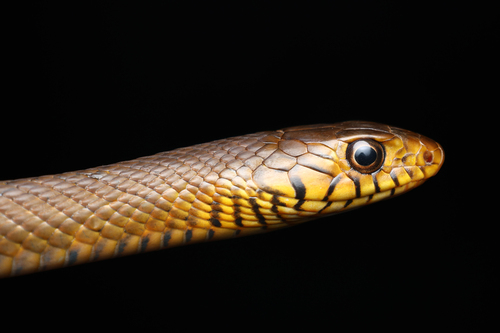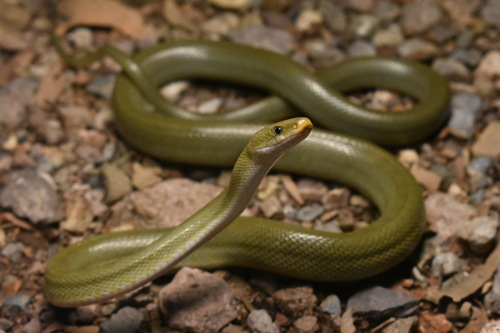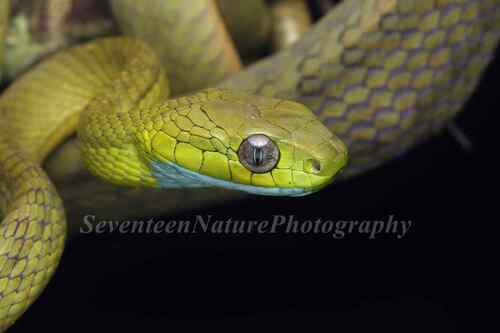
About Boiga cyanea (Duméril, Bibron & Duméril, 1854)
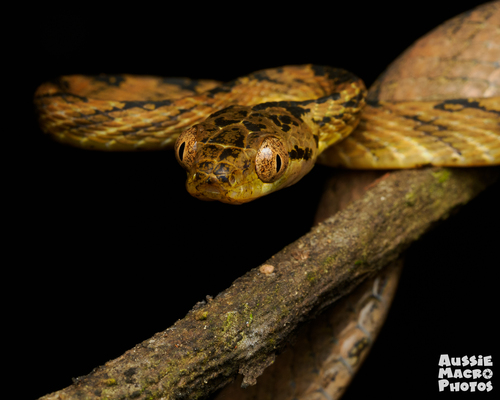
This medium to large, slightly laterally compressed, medium-bodied snake has a moderately long, prehensile tail. Its head is distinct from a narrow neck, with a rounded snout. The eyes are large, with vertically elliptical pupils, and are golden brown in color. Dorsal scales are smooth and bear single or double apical pits; ventrals have weak lateral keels. The dorsal scale count is usually 21–21 (23) –15. Its long prehensile tail means it is purely arboreal, though it can also move on the ground. The dorsal color is uniformly green, or green mixed with grayish or bluish tones. The belly is greenish or yellowish white. The top of the head is usually the same color as the dorsum, sometimes with a brownish tint. The upper lip is yellowish, and most scales on the head have black margins. Hatchlings are reddish brown with green heads; their color begins to change after 8 to 9 months of age. Adults reach a maximum total length of 190 cm, with a common total length of 115 cm (a common snout-vent length of 87 cm).
Boiga cyanea, the green cat snake, is distributed across Bangladesh, Bhutan, Cambodia, part of Yunnan in China, specific regions of India (Sikkim, Darjeeling, Jalpaiguri, West Bengal, Assam, Arunachal Pradesh, and the Andaman & Nicobar Islands), Laos, West Malaysia, Myanmar, Nepal, Thailand (including Phuket), and Vietnam.
This species occupies both terrestrial and arboreal niches, living in primary and secondary forests including montane zones, and is also found in coastal forests at sea level. It is a nocturnal, carnivorous snake with a very mild, sluggish disposition; it rarely attempts to escape when approached or handled, and is difficult to provoke into striking. By day it rests coiled among tree branches, and by night it actively hunts for prey, and is occasionally found moving on the ground while searching for food. It feeds mainly on lizards, and also preys on frogs, birds, rodents, and other snakes. As a rear-fanged, mildly venomous species, it can paralyze small prey. If threatened, it will adopt a hostile threat posture with a wide open mouth.
It is oviparous. Eggs are laid approximately 42 to 50 days after mating; clutches contain 7 to 14 eggs, laid from late winter to late summer. The incubation period is approximately 85 days.
Bites from this species are not expected to cause medically significant systemic effects; the only probable small risk is local secondary infection. People bitten by this species do not require specialized medical attention beyond checking for infection and confirming up-to-date tetanus immunity, and should be advised to return for care if local symptoms of secondary infection develop. Bites most often cause only mild to moderate local swelling and pain, with occasional local bruising, paresthesia/numbness, erythema, or bleeding. No cases involve necrosis or systemic effects. While most bite cases are minor and do not require hospital admission, some cases can be more severe and require admission and treatment, so bites should be carefully assessed before early discharge.