About Bogertophis subocularis (Brown, 1901)
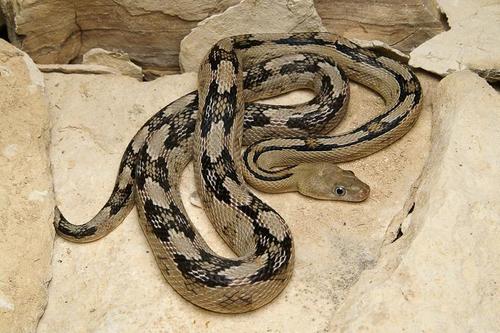
Bogertophis subocularis, commonly called the Trans-Pecos rat snake, can be identified by a row of small subocular scales between the lower edge of its eye and the upper labial scales. Its dorsal coloration ranges from yellow to tan, marked with a series of black or dark brown H-shaped patterns. It has a large, prominent, light-colored eye with a distinct round black pupil, and a pink tongue. At midbody, its dorsal scales are arranged in 31 to 35 rows. It has 260 to 277 ventral scales, and 69 to 79 subcaudal scales. Most adult Trans-Pecos rat snakes reach a total length of 90 to 137 cm (36 to 54 inches), and the maximum recorded total length for the species is 168 cm (66 inches). This species is distributed across the Mexican states of Chihuahua, Coahuila, Durango, and Nuevo León, with its range extending north into Texas and New Mexico in the United States. It inhabits desert flats, brushy slopes, and rocky outcrops, where it creates dens. The breeding season of Bogertophis subocularis occurs during May and June. Egg-laying starts in July and finishes by September. The species has an unusually long incubation period for a snake, lasting nearly three months. After incubation, clutches of 3 to 11 hatchlings emerge, each measuring 28–33 cm (11–13 in) in total length. Since hatching takes place in winter, hatchlings often stay hidden underground for several months before emerging above ground.