About Boerhavia coccinea Mill.
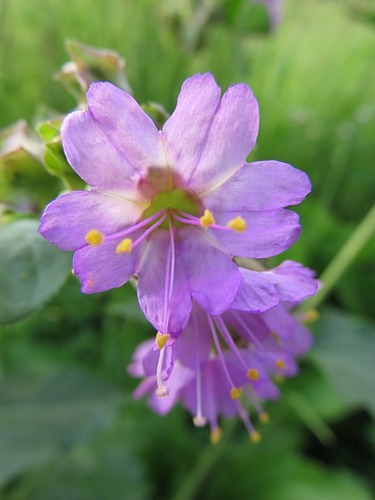
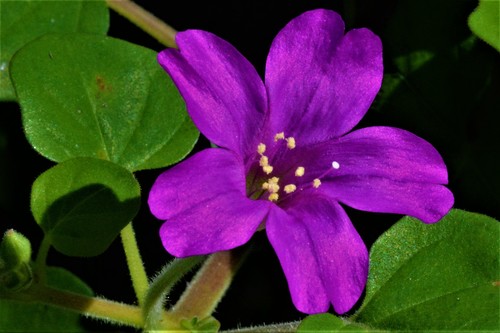
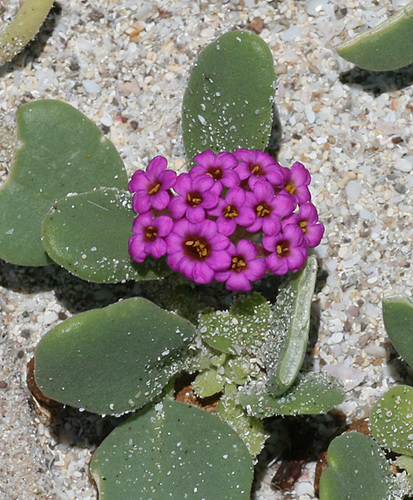
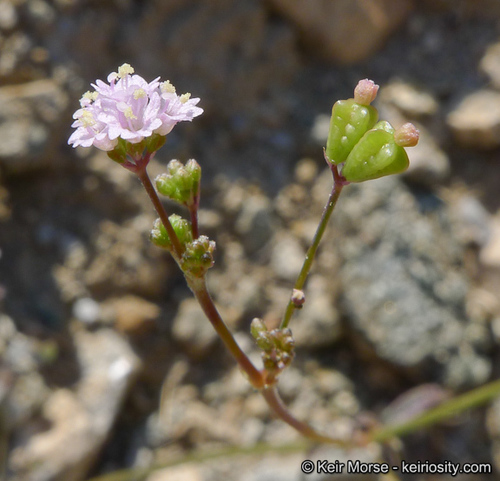
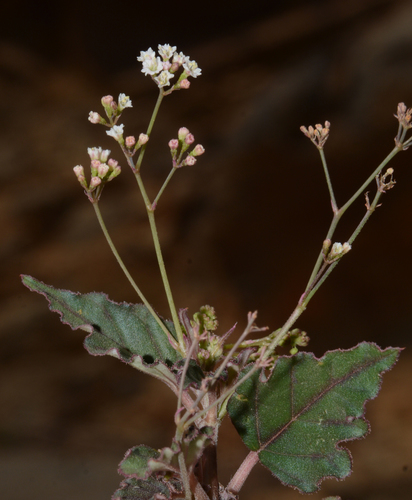
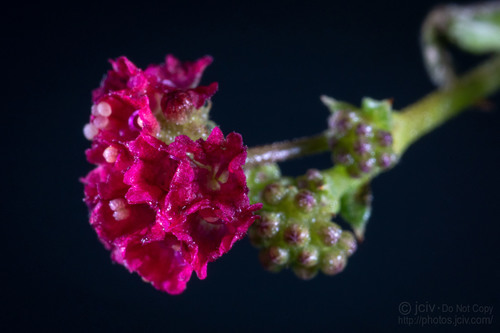
Boerhavia coccinea Mill. is a low-lying, sprawling perennial herb that can grow stems exceeding one meter in length. Its stems are somewhat hairy and sticky from glandular secretions. Its generally oval-shaped leaves grow on short petioles, have wavy edges, and may have reddish margins. The inflorescence forms a small head of tiny frilly flowers, each just a few millimeters long. Flowers are most often bright scarlet to red-violet, but can also appear in shades of pink, yellow, or white. This species grows in a wide variety of habitats, and it is a common roadside weed in disturbed areas. The native range of Boerhavia coccinea Mill. is not confirmed. It is generally considered native to the Americas, Africa, the Arabian Peninsula, the Indian subcontinent, and parts of Australia. Some evidence suggests the species originated between the southern United States and northern South America, and was introduced to other regions of the world through human activity. In Australia, the species' range has expanded due to human activity. In Africa, it has been recorded in Uganda, Kenya, and Tanzania. Uncertainty around its native range is made worse by the difficulty of telling species apart within the B. diffusa-B. coccinea complex. This plant has a long history of use for its medicinal properties. Leaves and roots are used medicinally in Cameroon, Ethiopia, Namibia, Nigeria, Tanzania, Mexico, Brazil, Argentina, and Paraguay. In traditional Mexican medicine, it is used to treat conditions including diarrhea and dysentery. It is most commonly used medicinally to treat pain and inflammation, due to its anti-inflammatory and antinociceptive properties. Research into the chemical basis for these properties is currently active. Boerhavia coccinea Mill. is also eaten by humans, used as animal feed, and its seeds can be processed into flour.