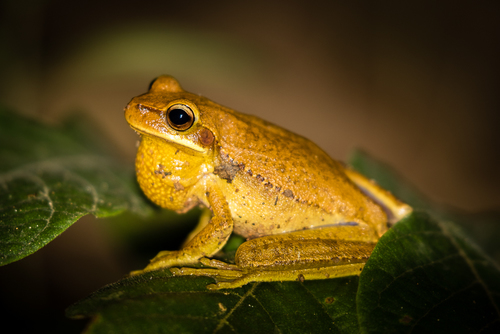
About Boana prasina (Burmeister, 1856)
Size
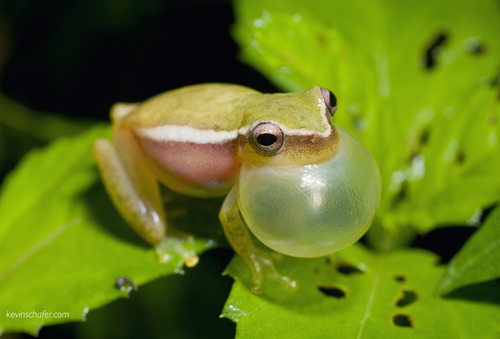
Boana prasina is a medium-sized frog that reaches 4 to 5 centimeters in length.
Dorsal Coloration
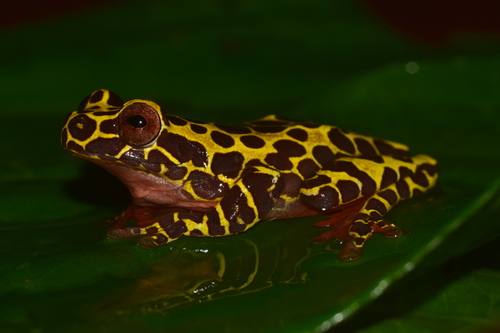
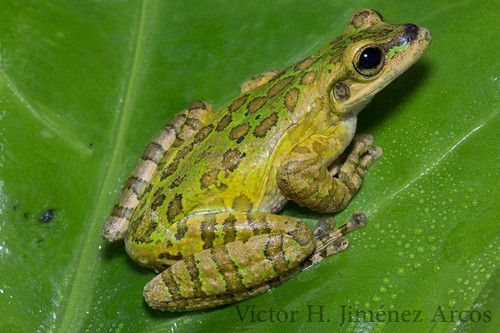
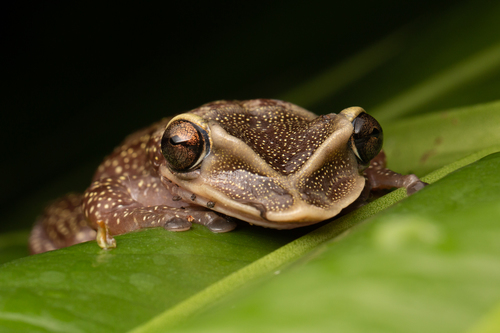
It is most commonly light brown with scattered dark spots across its back, though individuals may also be brown, yellow, or green.
Ventral Coloration
Its belly is a lighter shade than its back.
Common Name Origin
It is commonly called the rattle-voiced tree frog, named for its call which follows a rattle-like rhythm.
Calling Habitat
These frogs typically croak from low vegetation at the edge of water, and they have recently been observed living in artificial garden lakes and lawns.
Activity Pattern
The species is generally nocturnal, and individuals sometimes become active at dusk.
Geographic Range
B. prasina is restricted to the elevated regions of southeastern Brazil, but occupies a wide range of habitat types including lakes, ponds, fields, pastures, muddy soils, and forests.
Microhabitat Position
Individuals can be found either on the ground or in trees.
Forest Habitat Preferences
In forested areas, it most often inhabits open spaces or forest edges; these forests are always located very close to water, and are either riparian or gallery forests.
Tadpole Population Observation
A study of tadpole populations across 25 Atlantic Forest breeding sites in southern Brazil found only two groups of B. prasina tadpoles, each containing around 70 individuals.
Tadpole Breeding Substrate
While the 25 observed breeding sites were evenly split between ponds and streams, B. prasina tadpoles were only found living in streams.
Territoriality
B. prasina does not appear to exhibit territorial behavior.
Male Rivalry
Male rivalry, a common component of sexual selection in other frog species, is much less prominent in this species.
Male Calling Signal Function
One study proposed that the calling behavior of male B. prasina acts as an honest signal of an individual male's health: the study found that males with lower parasite intensity had higher calling rates.